
Australians: Could You Need $705,000–$920,000 of Life Insurance?

Australians: Could You Need $705,000–$920,000 of Life Insurance?
Work out how much life insurance you need by subtracting your available assets from your family’s financial obligations, covering the funeral, mortgage, debts, education and years of ongoing living costs. For a household with a mortgage and young kids, that gap can often be substantial, though the exact figure depends entirely on your own numbers. The step-by-step calculator method below shows you how to reach your own figure rather than guess at someone else’s.
TL;DR:
- Most Australians pay between $25 and $300 or more per month for life insurance, depending on age, health, and smoker status.
- Accurate obligations include funeral costs, current mortgage or rent, personal and business debts, and at least 10 to 15 years of income replacement.
- Assets that offset cover needs are superannuation death benefits, accessible savings, investments, and existing insurance, but not assets like the family home.
- Underestimating one obligation, such as a business loan or unpaid household work, can significantly inflate the required coverage amount.
- Regularly reviewing coverage after major life events ensures your policy adapts to changing financial responsibilities and family needs.
Table of Contents
- How much life insurance do you need? The calculator method
- What obligations should you actually include?
- Which assets actually offset your cover needs?
- Two worked examples from real Australian households
- What does life insurance actually cost in Australia?
- Cover through super versus buying outside super
- When should you review your cover?
- What advisers see going wrong with cover calculations
- How life insurance payouts are taxed in Australia
- Why the standard advice on life cover falls short
- Get a personalised life insurance quote from Amber Wealth
- Where to check the numbers yourself
- Sources
- FAQ
How much life insurance do you need? The calculator method
The calculation is simpler than most people expect once you break it into steps. It’s essentially the same logic behind the MoneySmart life insurance calculator, which totals your immediate needs plus the present value of ongoing costs, then subtracts what you already have.
Here’s the sequence to follow:
- List your immediate obligations. Funeral costs, the mortgage balance, personal loans, credit cards and any business debts you’ve personally guaranteed.
- Estimate ongoing costs. Add school fees, university costs for the kids, and the annual income your family would need to maintain their lifestyle.
- Choose a method for step 2. Either multiply the annual shortfall by the number of years support is needed, or calculate the present value of that income stream, which accounts for inflation and investment returns and usually produces a lower, more realistic number than simple multiplication.
- List your available assets. Superannuation death benefits, savings, investments, and any existing life cover.
- Subtract assets from obligations. The result is your suggested cover amount.
Present value calculations suit longer time horizons, say replacing income for 15 to 20 years, because they’re more accurate than a flat multiplication. Simple years times annual shortfall works fine for shorter, more predictable gaps, like covering a mortgage that will be paid off in eight years. Either way, running the numbers through a calculator beats guessing at a round figure that sounds about right.
What obligations should you actually include?
Getting the obligations side right matters more than people think, because underestimating even one line item throws off the whole calculation. Here’s what belongs on that list.
- Funeral costs. MoneySmart’s calculator defaults to $5,000, which is a reasonable starting point for a modest service, but increase it if you’d want a larger funeral or if costs in your area run higher [MoneySmart default funeral cost $5,000].
- Mortgage balance. Use your current outstanding balance, not the original loan amount. For investment properties, decide whether you want the debt cleared entirely or just reduced to a manageable rental-covered level.
- Other debts. Personal loans, car finance, credit cards and, importantly, any business loans you’ve personally guaranteed. Business owners often forget this last one, and it can be the largest single figure on the list.
- Children’s education. Estimate school fees through to Year 12, and add a rough figure for university or vocational training if that’s part of your plan.
- Ongoing living costs. This is the big one: what would your family actually need each year to maintain their current lifestyle, and for how many years?
Pro Tip: Don’t forget the value of unpaid work. If one partner handles childcare, school pickups and running the household, replacing that with paid help after a death can cost more than people assume, so it deserves its own line in the calculation, not an afterthought.
Business loans and personal guarantees deserve particular attention. If you’ve signed a personal guarantee for a commercial lease or equipment finance, that debt doesn’t disappear with the business, it follows you personally, and your cover needs to reflect that.
Which assets actually offset your cover needs?
Once your obligations are listed, the next step is working out what your family could realistically access without you. This is where a lot of people either overestimate what they have or forget to check the fine print on what they think they have.
- Superannuation death benefit. Check your most recent statement for the account balance plus any insured death benefit attached to your super fund.
- Savings and investments. Include only what’s genuinely accessible, term deposits and managed funds count, but don’t include assets your family would need to sell the family home to access.
- Existing life insurance. Any standalone policies or default cover through super, added together.
There’s a trade-off worth understanding if your private health insurance premiums come out of super: every dollar spent on insurance premiums is a dollar not compounding toward your retirement balance. Over 20 or 30 years, that can meaningfully affect your eventual retirement savings, even though insurance through super is often cheaper upfront because premiums come from pre-tax contributions rather than take-home pay.
Before relying on any of these figures, check the policy definitions and maximum payout amounts. Default super cover often has a lower maximum than people assume, and TPD definitions vary significantly between funds.
Two worked examples from real Australian households
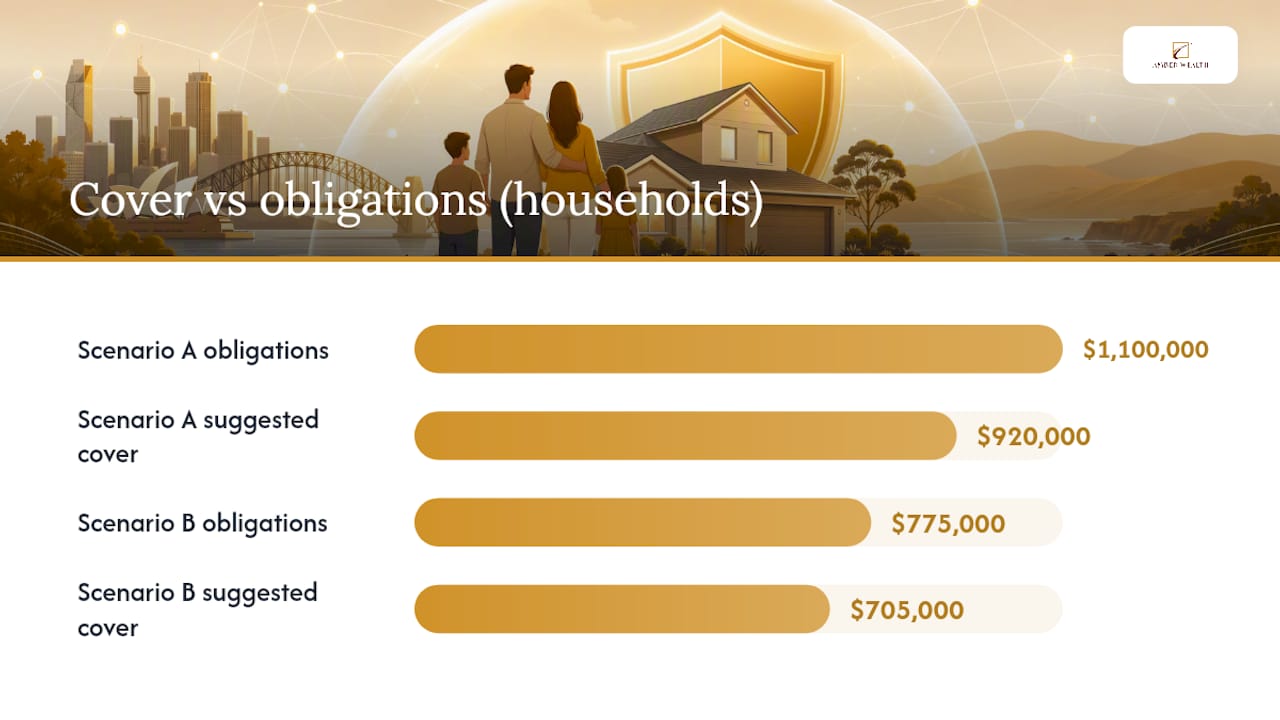
Numbers make more sense with a real scenario attached, so here are two common household types and how the gap formula plays out for each.
Scenario A: dual-income family with a mortgage
- Funeral: $5,000
- Mortgage balance: $550,000
- Other debts (car loan, credit card): $25,000
- Education costs for two kids to Year 12 plus partial university: $120,000
- Ongoing income replacement (10 years, present value): $400,000
- Total obligations: $1,100,000
- Assets: super death benefit $150,000, savings $30,000
- Total assets: $180,000
- Suggested cover: $920,000
Scenario B: single parent, single income
- Funeral: $5,000
- Mortgage or rent buffer: $200,000
- Other debts: $10,000
- Education costs for one child: $60,000
- Ongoing income replacement (15 years, present value): $500,000
- Total obligations: $775,000
- Assets: super death benefit $60,000, savings $10,000
- Total assets: $70,000
- Suggested cover: $705,000
Notice the single-parent scenario needs a longer income replacement period, because there’s no second income to fall back on. In both cases, it’s worth rounding up rather than down. Finder’s analysis points to widespread underinsurance across Australian households, and a buffer of an extra 10 to 15% covers cost blowouts, unexpected medical bills, or the homemaker replacement value that’s easy to underestimate.
What does life insurance actually cost in Australia?
Premiums vary enormously based on age, smoker status, cover amount and policy type, but you can expect a broad range rather than a single number. Market data suggests most Australians pay somewhere between roughly $25 and $300 or more per month, depending heavily on those factors. Canstar’s cost analysis shows non-smokers in their thirties typically sit toward the lower end of that range, while older applicants, smokers and those seeking higher cover amounts pay considerably more.
A few things move the number most:
- Age at application. Premiums climb steadily each year, so locking in cover earlier tends to lock in a lower starting rate.
- Smoker status. Smokers often pay double what non-smokers pay for identical cover.
- Stepped versus level premiums. Stepped premiums start cheaper but rise every year with age; level premiums cost more upfront but stay flatter over the decades, which can work out cheaper long term if you hold the policy for years.
- Cover amount and policy type. A $1,000,000 policy costs proportionally more than a $300,000 one, though not always in a straight line, insurers often price larger sums more efficiently per dollar of cover.
Cover through super versus buying outside super
Both routes get you life cover, but they work differently, and the right choice often depends on how complex your finances already are.
- Cost. Super-based cover is often cheaper because premiums come from pre-tax super contributions rather than after-tax income.
- Ease. Default cover through super requires no application, it’s often automatic once your balance meets a threshold.
- Limits. Default cover amounts are frequently far lower than what a full needs calculation suggests, particularly for people with mortgages or dependants.
- Retirement trade-off. Every premium dollar paid from super is a dollar that stops compounding toward retirement.
- TPD definitions. Total and Permanent Disability definitions inside super policies can be stricter than standalone policies, and payout eligibility isn’t always straightforward.
Pro Tip: Before assuming your default super cover is enough, ask three questions: what’s the actual insured amount, what’s excluded, and would the payout definition actually apply to your occupation if something went wrong?
When should you review your cover?
Life insurance isn’t a set-and-forget decision. Circumstances change, and your cover should change with them.
- Marriage or a new relationship. Shared financial obligations usually mean shared insurance needs.
- A new child. Education costs and ongoing income replacement both jump significantly.
- Buying a home or increasing your mortgage. Your largest single obligation just grew.
- Business changes. New loans, partnerships or personal guarantees all shift your risk profile.
- Approaching retirement. Your income replacement needs typically shrink as super and other assets grow.
As a general rule, review your cover annually or immediately after any of the events above. Before a review, gather your current mortgage balance, your latest super statement, your savings balance, and either run the numbers through a calculator yourself or book a session with an adviser.
What advisers see going wrong with cover calculations
Adam Sobczak, Director and Senior Financial Planner at Amber Wealth, works with Melbourne households on exactly this calculation as part of broader personal insurance advice. The most common mistake he sees is over-reliance on default super cover without checking whether it actually matches the household’s obligations. The second is ignoring homemaker value entirely, treating unpaid household work as if it costs nothing to replace, when in reality it often doesn’t.
How life insurance payouts are taxed in Australia
Most life insurance payouts in Australia are tax-free when paid directly to a spouse, child, or other financial dependant. This is the simplest and most common scenario: a policy held outside super, paid to a dependant, generally arrives without any tax deducted.
The picture changes when the policy is held inside superannuation, which is common with default cover. If the death benefit is paid to a dependant (a spouse, a child under 18, or someone financially dependent on the deceased), it’s typically still tax-free. If it’s paid to a non-dependant, an adult child who was financially independent, for example, the taxable component of the benefit can attract tax, generally up to 30% plus the Medicare levy, depending on how the benefit is structured.
TPD payouts follow different, more complex rules again, particularly when paid from a super fund, and the tax treatment can depend on the recipient’s age and relationship to the deceased or disabled person. Trauma insurance payouts, held outside super, are generally tax-free regardless of who receives them.
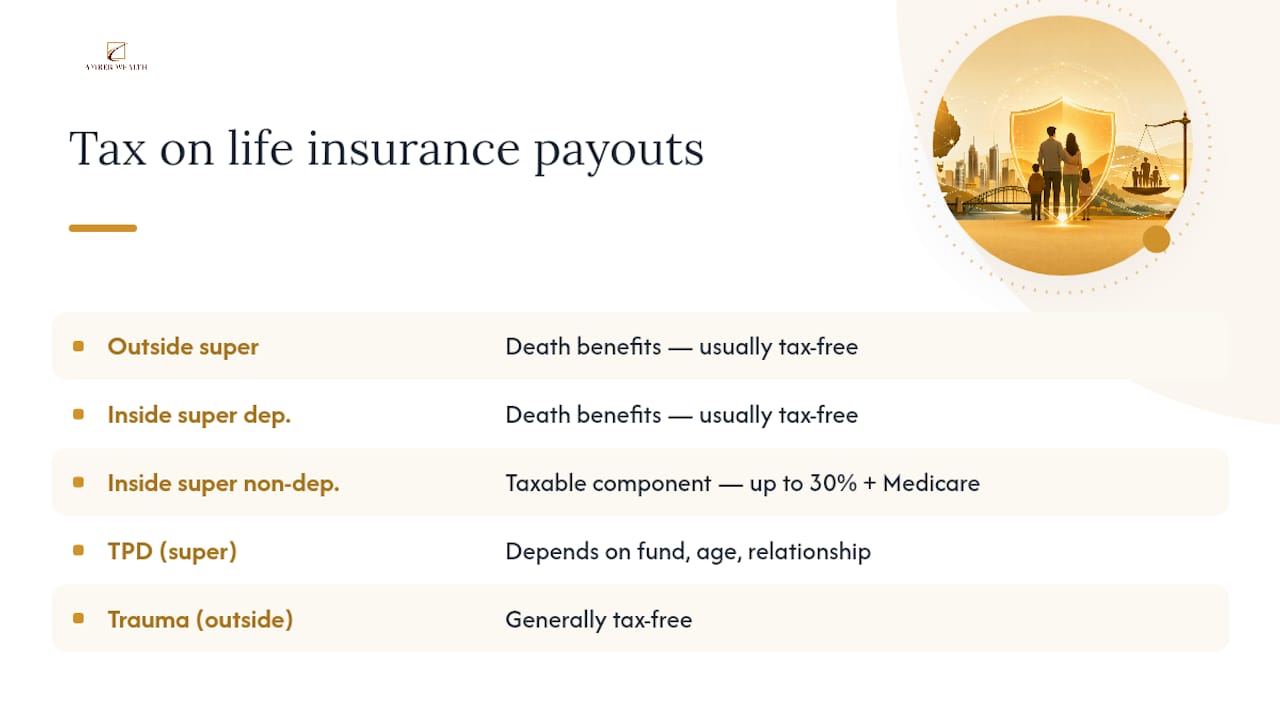
Because these rules depend on your fund’s structure, your beneficiary nominations and your personal circumstances, treat this as general background rather than a definitive answer for your situation. A financial adviser or tax professional can confirm exactly how a payout would be treated in your case before you finalise beneficiary nominations or decide between super and non-super cover.
Why the standard advice on life cover falls short
Most guidance stops at “multiply your income by ten” or some similarly blunt rule of thumb. That approach ignores the two things that actually drive the number: your debts and your dependants’ timeline. A 35-year-old with a $600,000 mortgage and two toddlers needs a completely different figure to a 35-year-old renter with no kids, yet a flat income multiple treats them the same.
The gap method fixes this because it forces you to look at your actual obligations rather than a proxy for them. Where I think people get it wrong is in the assets column, not the obligations column. They either forget to check their super death benefit at all, or they overestimate what’s genuinely accessible without disrupting the rest of their financial plan.
If you take one thing from this, prioritise getting your obligations list right before worrying about premium cost. A cover amount that’s $200,000 short because you forgot the business loan is a bigger problem than paying an extra $15 a month for level premiums. Get the number right first, then worry about how to pay for it.
— Adam
Get a personalised life insurance quote from Amber Wealth
Running the calculator yourself gets you a solid starting figure, but it can’t account for business loans with unusual structures, multiple super accounts spread across different funds, or the tax treatment of a payout that lands outside a straightforward dependant scenario. That’s where a proper insurance review earns its keep, particularly if your finances have grown more complicated since you last checked your cover.

Amber Wealth’s personal insurance advice service works through your full financial picture, not just a single calculator output, and checks how your life, TPD and income protection cover fit together with your broader retirement and superannuation strategy. The table below outlines when it’s worth bringing in a professional rather than relying on a self-calculated figure.
| Your situation | Recommended approach |
|---|---|
| Straightforward income, no business debts | Self-calculate with MoneySmart’s tool as a starting point |
| Business loans, personal guarantees, or multiple super funds | Book a personalised insurance review |
| Nearing retirement with existing cover | Review whether cover amount still matches reduced obligations |
| Recently married, new child, or new mortgage | Recalculate and consider an adviser check |
If your circumstances fit the second, third or fourth row, request a life insurance quote through Amber Wealth and get a cover recommendation built around your actual numbers, not a generic multiple.
Where to check the numbers yourself
- MoneySmart’s life insurance calculator for a free, government-run first-pass estimate.
- MoneySmart’s life cover guide for a plain-English explanation of who typically needs cover.
- Canstar’s cost breakdown for Australian premium averages by age and gender.
This article is general information, not a substitute for advice from a qualified financial advisor. Consult a qualified financial professional about your own circumstances before acting on anything here.
Sources
- Moneysmart
- Life cover - MoneySmart
- How Much Does Life Insurance Cost in Australia? — Canstar
- How Much Life Insurance Do You Need? — Finder
FAQ
How much does a $1,000,000 life insurance policy cost per month?
Premiums vary widely by age, health and smoker status, but based on broad Australian market ranges, non-smokers in their thirties typically sit toward the lower end of the typical $25 to $300 or more per month band, while older applicants or smokers pay more.
How much is life insurance per month in Australia?
Most Australians pay somewhere between roughly $25 and $300 or more per month, with the exact figure depending on age, cover amount, smoker status and whether premiums are stepped or level.
How much does a $500,000 life insurance policy cost per month?
A $1,000,000 policy costs proportionally more than smaller amounts, and for a healthy non-smoker in their thirties or forties premiums often fall toward the lower end of typical Australian ranges, though individual quotes vary.
How much does $300,000 life insurance cost?
$300,000 of cover is usually among the more affordable options, particularly for younger, healthy non-smokers, and tends to sit near the lower end of typical Australian premium bands.
How do I know if my current cover is enough?
Run your numbers through the gap formula, obligations minus assets, and compare the result to your existing cover; if there’s a shortfall, consider a personalised insurance review to check the details against your actual circumstances.
Recommended
This article is general information, not a substitute for advice from a qualified financial advisor. Consult a qualified financial professional about your own circumstances before acting on anything here. General Advice Warning Disclaimer: The information on this website is general information only and is not intended to be a recommendation. We strongly recommend you seek advice from your financial adviser as to whether this information is appropriate to your needs & financial situation.
Adam Sobczak
Director and Principal Adviser, Amber Wealth
Amber Wealth is a Corporate Authorised Representative of Lifespan Financial Planning Pty Ltd, AFSL 229892.
Book a complimentary consultationLooking for professional advice on insurance?
Explore our Personal Insurance service →

