
Non-concessional contributions: 2026 rules and caps explained

From 1 July 2026, the non-concessional contributions cap rises to $130,000 per financial year. These are after-tax super contributions — money you put into superannuation from your personal savings, an inheritance, or asset sale proceeds, with no further tax on entry provided you stay within the cap.
Before you make a large lump-sum contribution, three things need checking:
- Your total super balance (TSB) as at 30 June of the prior year — this determines whether you can contribute at all and how much bring-forward you can access.
- Your bring-forward status — if you triggered a bring-forward arrangement in a prior year, your available cap may already be partially or fully used.
- Your fund’s acceptance rules — most funds require your Tax File Number (TFN) to accept after-tax contributions.
The Australian Taxation Office (ATO) is the definitive source for cap figures and eligibility rules. Australian Retirement Trust and other major funds publish practical guidance on how to make after-tax contributions at the fund level. For personalised planning around lump-sum top-ups, bring-forward strategies, or how a large contribution interacts with your Age Pension entitlement, Amberwealth provides tailored advice across Victoria, New South Wales, South Australia, and Tasmania.
Table of Contents
- What are non-concessional contributions and what counts?
- What is the current non-concessional cap and how has it changed?
- How the bring-forward rule works, with worked examples
- Who cannot make non-concessional contributions?
- Contributions that don’t count towards the non-concessional cap
- How to check your cap usage, bring-forward status, and total super balance
- Practical Amberwealth guidance: when does a non-concessional top-up make sense?
- Key takeaways
- Why non-concessional contributions deserve more attention than they get
- Amberwealth can help you plan your super contributions
- Where to read more
What are non-concessional contributions and what counts?
Non-concessional contributions are amounts you contribute to super from money that has already been taxed — your take-home pay, personal savings, an inheritance, or proceeds from selling an asset. They are distinct from concessional contributions (employer super guarantee payments, salary sacrifice, and personal contributions for which you claim a tax deduction), which are taxed at 15% on entry into the fund.
The ATO’s guidance on concessional and non-concessional contributions is clear: because non-concessional amounts have already been taxed in your hands, they are not taxed again when they enter super. Once inside the fund, earnings are taxed at a maximum of 15% in accumulation phase, or potentially zero in pension phase — which is the core reason this strategy appeals to pre-retirees with taxable assets sitting outside super.
Common sources that count as non-concessional contributions include:
- Personal savings transferred as a lump sum
- After-tax salary contributions not claimed as a deduction
- Proceeds from selling an investment property or shares (after CGT)
- Inheritances or gifts deposited directly into super
- Spouse contributions made on behalf of a partner
One point that catches people out: if you make a personal contribution intending to claim a tax deduction, you must lodge a valid Notice of Intent to claim a deduction with your fund before you lodge your tax return or commence a pension. Without an acknowledged notice, the contribution remains non-concessional and counts against that cap instead of the concessional cap.
Contributions to multiple funds are aggregated. If you have an industry fund and a self-managed super fund (SMSF), every dollar you contribute to both counts toward the same annual cap.
What is the current non-concessional cap and how has it changed?
The annual cap for 2026–27 is $130,000, up from $120,000 in 2025–26. This increase reflects the first indexation of the cap in several years, with the cap now reviewed annually in line with average weekly ordinary time earnings (AWOTE) as confirmed by the ATO’s contributions caps resource.

The non-concessional cap is set at four times the concessional cap. When the concessional cap rose to $30,000 for 2024–25 and remained there for 2025–26, the non-concessional cap held at $120,000. The 2026–27 increase to $130,000 follows the concessional cap moving to $32,500 for 2026–27.
| Financial year | Annual non-concessional cap | 3-year bring-forward maximum |
|---|---|---|
| Recent years | generally consistent with indexed thresholds | |
| Current year | aligned with current capped limits as set by the ATO |
The Morningstar summary of 2026–27 threshold changes also notes the general transfer balance cap rises to $2.1 million from 1 July 2026. That figure matters because once your TSB reaches the general transfer balance cap, your non-concessional cap drops to nil — you cannot make any further after-tax contributions.
How the bring-forward rule works, with worked examples
The bring-forward rule lets eligible members contribute up to three years’ worth of non-concessional contributions in a single financial year. It is not something you apply for. The arrangement triggers automatically the moment you contribute more than the annual cap in a financial year.
Eligibility and TSB thresholds for 2026–27
Your TSB as at 30 June 2026 determines your eligibility for bring-forward arrangements, with thresholds set in line with prevailing transfer balance caps and contribution caps, subject to indexation. Higher balances progressively reduce or eliminate bring-forward entitlements and caps.
Age also matters. You must be under age 75 at the time of contribution to make non-concessional contributions. The bring-forward rule applies to members under age 75 at the start of the financial year in which they trigger it.
How the cap is fixed once triggered
Once you trigger a bring-forward, your total entitlement for that period is locked at the cap that applied in the year you triggered it. Indexation during the remaining years of the period does not increase your available amount.
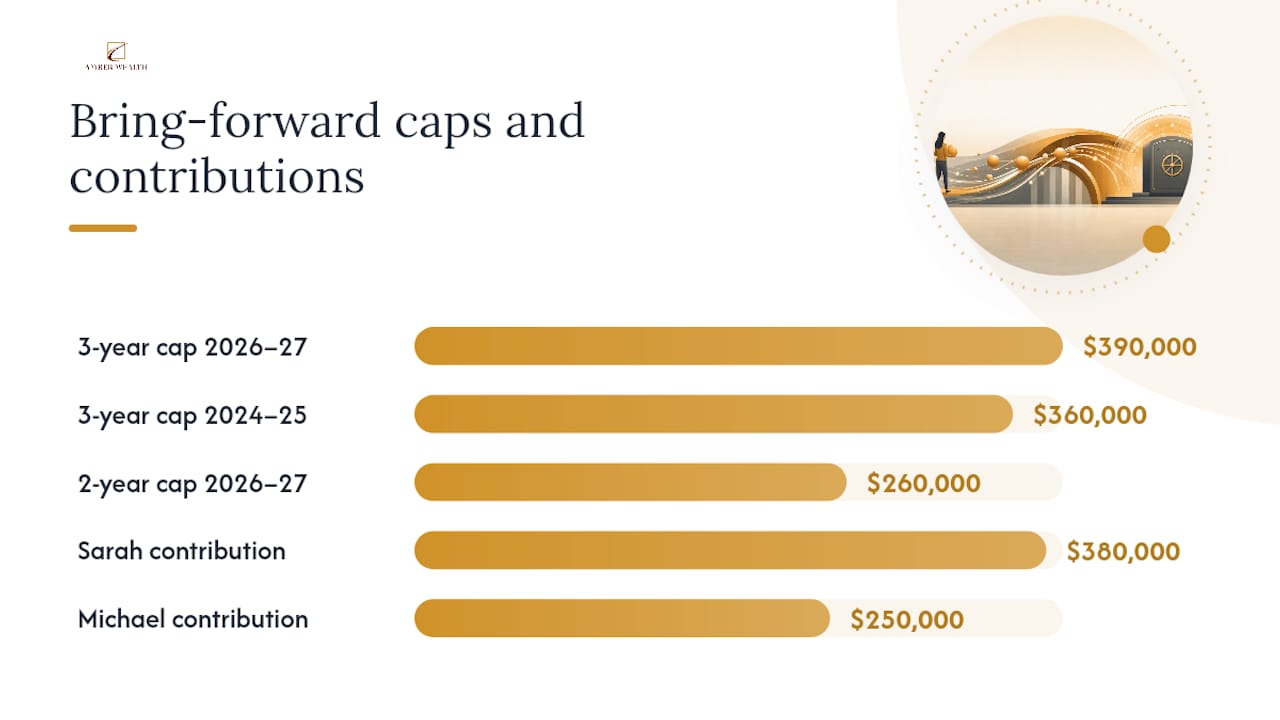
Pro Tip: Many people assume that if the cap rises mid-way through their bring-forward period, they get access to the higher cap. They don’t. If you triggered a 3-year bring-forward in 2024–25 with a $360,000 entitlement, that figure is fixed for all three years regardless of the 2026–27 increase to $390,000.
Worked example 1: Full 3-year bring-forward (2026–27)
Sarah is 58 years old. Her TSB on 30 June 2026 is $900,000. She receives an inheritance of $380,000 and wants to contribute as much as possible to super in 2026–27.
- Her TSB is below $1.66 million, so she can access the full 3-year bring-forward.
- Maximum contribution in 2026–27: $390,000 (3 × $130,000).
- She contributes $380,000 — within the limit.
- The bring-forward is triggered. Her remaining entitlement for 2027–28 and 2028–29 combined is $10,000.
- She cannot make further non-concessional contributions until the bring-forward period ends (after 2028–29), except for that remaining $10,000.
Worked example 2: 2-year bring-forward (2026–27)
Michael is 62. His TSB on 30 June 2026 is $1.72 million. He sells an investment property and wants to contribute $250,000 to super.
- His TSB sits between $1.66 million and $1.79 million, so only a 2-year bring-forward applies.
- Maximum contribution: $260,000 (2 × $130,000).
- He contributes $250,000 — within the 2-year limit.
- His remaining entitlement for 2027–28 is $10,000.
- He cannot trigger a fresh bring-forward until the current period expires.
Who cannot make non-concessional contributions?
The most common reason someone’s non-concessional cap is nil is a TSB at or above the general transfer balance cap — $2.1 million from 1 July 2026. At that point, the ATO’s non-concessional contributions cap rules are unambiguous: no after-tax contributions are permitted.
Beyond the TSB threshold, other restrictions apply:
Age limits. Typically, members aged 75 and over are ineligible for non-concessional contributions. For ages 67 to 74, eligibility often depends on meeting the work test or qualifying for an exemption, except for certain contributions such as downsizer contributions.
Fund acceptance rules. Your fund must be willing and able to accept the contribution. Most regulated funds will accept after-tax contributions from members under 75 who provide their TFN. Without a TFN on file, some funds are restricted from accepting personal contributions.
Bring-forward already fully used. If you triggered a bring-forward in a prior year and have used the full entitlement, you cannot contribute again until the bring-forward period expires, even if the annual cap has since increased.
Defined benefit funds. Members of certain defined benefit schemes may face different or additional restrictions on non-concessional contributions. Check directly with your fund.
Contributions that don’t count towards the non-concessional cap
Several contribution types are excluded from the non-concessional cap, but the exclusion is not automatic. You must notify your fund and provide the correct form, generally before or at the time of contribution. Fail to do that, and the amount is reported as a personal contribution and counts against your cap.
Key excluded contributions:
- Downsizer contributions — if you are aged 55 or over and sell your principal residence, you can contribute up to $300,000 per person ($600,000 per couple) from the proceeds. These sit outside the non-concessional cap entirely. You must lodge the ATO’s downsizer contribution form with your fund at or before the time of contribution.
The paperwork requirement is the critical point. The ATO’s guidance on understanding concessional and non-concessional contributions is explicit: without the relevant election or notification form lodged on time, the exclusion does not apply.
How to check your cap usage, bring-forward status, and total super balance
The most reliable way to check your position is through myGov, linked to ATO online services. Log in, navigate to “Super,” and you can view:
- Your TSB as at 30 June of the prior financial year
- Contributions reported by your fund(s) for the current and prior years
- Any active bring-forward arrangement and the remaining entitlement
- Your concessional and non-concessional cap usage year to date
Because contributions across all your funds are aggregated, myGov is the only place that shows the combined picture. Your individual fund statement shows only what that fund has received — it will not flag if you are close to the cap across multiple accounts.
Practical steps before making a large contribution:
- Log into myGov and confirm your TSB as at 30 June of the prior year.
- Check whether a bring-forward arrangement is active and how much entitlement remains.
- Confirm your fund has your TFN on file — call or log into your fund’s member portal.
- If you are making a downsizer or CGT cap contribution, download and complete the relevant ATO form before transferring funds.
- Keep records: contribution receipts, fund confirmation letters, and any election forms lodged.
AustralianSuper’s guidance on after-tax contributions also notes that funds can show your contribution progress through their member portals, though the ATO’s aggregated view via myGov remains the definitive check. The SuperGuide non-concessional contributions guide is a useful secondary reference for eligibility notes and planning context.
Pro Tip: If you have multiple super accounts, consider consolidating before making a large contribution. Fewer accounts means less risk of losing track of aggregated cap usage, and it simplifies the myGov view.
Practical Amberwealth guidance: when does a non-concessional top-up make sense?
The mechanics are one thing. The harder question is whether a large after-tax contribution is the right move for your situation.
When it tends to make sense:
- You have received a windfall — an inheritance, a property sale, or a business sale — and the money would otherwise sit in a high-tax environment outside super.
- You are within 10 years of retirement and want to shift taxable assets into the low-tax super environment before you start drawing a pension.
- Your TSB is well below the transfer balance cap and you have bring-forward capacity available.
- You have already maximised concessional contributions for the year and have surplus cash.
When to pause and think carefully:
- The contribution would leave you short of cash for living expenses or an upcoming large purchase. Super is illiquid until you meet a condition of release.
- You are approaching Age Pension age and a higher super balance could reduce your entitlement. The interaction between super balances and the Age Pension assets test is not straightforward and varies by relationship status and asset mix.
- Your TSB is close to the transfer balance cap — a large contribution now could limit your ability to contribute in future years.
- You are considering an SMSF and have not yet assessed whether the structure suits your balance and complexity tolerance.
Pre-contribution checklist:
- Confirm TSB via myGov as at 30 June of the prior year
- Verify bring-forward status and remaining entitlement
- Check fund acceptance rules and TFN status
- Identify whether any exclusion (downsizer, CGT cap) applies and obtain the relevant form
- Estimate the impact on Age Pension entitlement if you are within five years of pension age
- Consider sequencing: concessional contributions first (lower cap, tax deduction available), then non-concessional
For readers planning for retirement early, the timing of non-concessional contributions relative to pension commencement can significantly affect long-term outcomes.
When to speak with Amberwealth:
Complex bring-forward scenarios, SMSF suitability questions, Centrelink interactions, or situations where your TSB is approaching the transfer balance cap all benefit from personalised advice. A pre-contribution review with an adviser can identify sequencing opportunities and flag risks that a myGov check alone will not surface. Amberwealth’s superannuation and SMSF advice service covers exactly these scenarios for pre-retirees and retirees across Victoria, New South Wales, South Australia, and Tasmania.
Key takeaways
The single most important rule: your non-concessional contributions cap and bring-forward access are both determined by your total super balance on 30 June of the prior year, so check that figure in myGov before you transfer a dollar.
| Point | Details |
|---|---|
| 2026–27 annual cap | The non-concessional cap is $130,000 from 1 July 2026, up from $120,000. |
| Bring-forward maximum | A TSB below $1.66 million unlocks a 3-year bring-forward of up to $390,000 for 2026–27. |
| Nil cap threshold | A TSB at or above $2.1 million (transfer balance cap) means no after-tax contributions are permitted. |
| Exclusions need paperwork | Downsizer, personal injury, and CGT cap contributions must be notified to your fund with the correct form at or before contribution. |
| Amberwealth | Personalised superannuation and retirement planning advice for pre-retirees navigating bring-forward decisions, SMSF suitability, and Age Pension interactions. |
Why non-concessional contributions deserve more attention than they get
Most of the public conversation about super focuses on the employer guarantee rate or concessional contribution limits. Non-concessional contributions get treated as an afterthought — something you do if you happen to have a windfall. That framing undersells them considerably.
For pre-retirees with assets sitting in taxable environments outside super, a well-timed after-tax contribution is one of the most tax-efficient moves available in the Australian system. The earnings on those assets inside super are taxed at a maximum of 15% in accumulation, and potentially zero once you commence a pension. Over a 10-to-15-year horizon, that difference compounds in a way that most people do not fully model before they act.
The risk, though, is real. Exceeding the cap by even a small amount triggers the ATO determination process, and leaving excess in super means tax at 47%. The bring-forward rules are genuinely complex, especially when a prior-year arrangement is still active or when the TSB sits close to a threshold. The 2026–27 indexation increase adds another layer: people who triggered a bring-forward in 2024–25 or 2025–26 do not get the benefit of the higher cap, and many will not realise that until they try to contribute again.
The other thing worth saying plainly: the Age Pension interaction is frequently underestimated. Shifting assets into super can reduce assessable assets under the assets test, which may improve pension entitlement — but the timing relative to pension age matters, and the rules differ for account-based pensions versus accumulation accounts. Getting that sequencing right is where personalised advice earns its keep.
Amberwealth can help you plan your super contributions
Putting a large sum into super is not a set-and-forget decision. The cap rules, bring-forward calculations, and Age Pension interactions all depend on your specific balance, age, and financial position — and the cost of getting it wrong (47% tax on excess contributions) is high enough that a pre-contribution review pays for itself.

Amberwealth works with pre-retirees, retirees, professionals, and families across Victoria, New South Wales, South Australia, and Tasmania to build personalised super contribution strategies. Whether you are assessing a bring-forward arrangement, evaluating an SMSF, or working out how a lump-sum contribution affects your Age Pension entitlement, the team provides clear, practical advice grounded in your numbers.
Use the superannuation calculator to model the impact of a lump-sum contribution on your projected retirement balance, or book a consultation through Amberwealth’s retirement planning advice page to discuss your specific situation with an adviser.
This article contains general information only and does not constitute personal financial advice. Contribution rules, caps, and thresholds change regularly. Confirm current figures with the ATO or a qualified financial adviser before acting.
Where to read more
The following primary sources were used in this article and are the definitive references for caps, eligibility, and ATO processes:
-
Non-concessional contributions cap | ATO — current cap, bring-forward eligibility thresholds, and ENCC determination process. The primary source for the $130,000 cap from 1 July 2026.
-
Understanding concessional and non-concessional contributions | ATO — definitions, exclusions, election form requirements, and aggregation rules across multiple funds.
-
Non-concessional super contributions guide (2026–27) | SuperGuide — practical planning commentary, eligibility notes, and expert perspective on using after-tax contributions in wealth planning.
-
Make after-tax super contributions | AustralianSuper — fund-level guidance on how to make after-tax contributions, TFN requirements, and monitoring contribution progress.
-
Key changes to 2026–27 super thresholds | Morningstar Australia — summary of the 2026–27 threshold changes including the transfer balance cap increase to $2.1 million and updated bring-forward maximums.
Recommended
Adam Sobczak
Director and Principal Adviser, Amber Wealth
Amber Wealth is a Corporate Authorised Representative of Lifespan Financial Planning Pty Ltd, AFSL 229892.
Book a complimentary consultationLooking for professional advice on superannuation?
Explore our Superannuation & SMSF Advice service →