
Australian Retirement Bucket Strategy: Size Using the Age Pension

Australian Retirement Bucket Strategy: Size Using the Age Pension
A retirement bucket strategy splits your savings into separate time-based pools—short-term cash, medium-term conservative assets, and long-term growth investments—so you can fund daily expenses without selling shares in a downturn. It suits retirees who want predictable income and fewer sleepless nights when markets fall. Done well, the approach protects your growth assets from forced selling while your short-term bucket buys you time to ride out volatility.
TL;DR:
- Sizing your buckets based on your actual shortfall after guaranteed income prevents excess cash accumulation and preserves long-term growth potential.
- Maintaining a disciplined refill process and reviewing your buckets annually helps avoid emotional decisions and keeps your strategy aligned with market conditions.
- Using cash for only one to two years of expenses and longer-term assets for ten or more years is key to reducing sequence-of-returns risk.
- Ignoring the impact of inflation on cash holdings can erode your safety buffer over time, especially if the cash bucket exceeds your shortfall needs.
- A personalized approach, considering your income, expenses, and risk tolerance, offers better protection than fixed rule-of-thumb ratios.
Table of Contents
- What is the retirement bucket strategy?
- How does the bucket strategy work in practice?
- How do you size your buckets for your own situation?
- What should you hold in each bucket?
- How do you maintain a bucket strategy over time?
- What are the pros and cons of a bucket strategy?
- How would a financial planner apply this in practice?
- What the bucket strategy gets right, and where it’s oversold
- How Amber Wealth can help you build your buckets
- Further reading and primary sources
- Sources
- FAQ
What is the retirement bucket strategy?
The bucket strategy divides your retirement savings by when you’ll need to spend them, not by asset class alone. Morningstar’s bucket model typically frames this as three horizons: short-term (1 to 3 years), medium-term (3 to 10 years), and long-term (10 or more years). Each bucket carries a different job.
- Short-term bucket: cash and near-cash, covering living expenses without market exposure.
- Medium-term bucket: conservative income assets, bridging the gap while markets recover.
- Long-term bucket: growth assets left alone to compound for a decade or more.
The logic is behavioural as much as financial. Retirees who need to sell shares during a crash lock in losses at the worst possible time, a risk known as sequence-of-returns risk. Separating “spending money” from “growing money” removes that pressure. Guaranteed income streams, including the Age Pension or a defined-benefit pension, reduce how much you need to hold in the short-term bucket in the first place.
How does the bucket strategy work in practice?
The mechanics come down to two things: how much sits in each bucket, and the order you draw from them. A common rule of thumb is one to two years of expenses in cash, five to eight years in conservative income assets, and the remainder in growth investments, though Kiplinger’s guidance notes these ranges shift with your risk tolerance and life stage.
The refill sequence usually runs in this order:
- Draw guaranteed income first, Age Pension payments, defined pensions, or annuity income.
- Top up any shortfall from the short-term cash bucket.
- When cash runs low, refill it from income or maturities in the medium-term bucket.
- Only tap the long-term bucket to rebalance or replenish others, ideally when markets are up.
Morningstar’s research on the bucket approach points to refill discipline as the hardest part to get right in practice, deciding exactly when and from where to rebuild the cash bucket during volatile markets. Reviewing bucket levels annually, or whenever cash drops below a set threshold, keeps the process from becoming an emotional decision made mid-crisis.
How do you size your buckets for your own situation?
Bucket sizing starts with your actual shortfall, not your gross living costs. Work out your annual expenses, then subtract the Age Pension and any other guaranteed income, defined pension, rental income, or part-time earnings. What’s left is the amount your buckets actually need to fund.
- Calculate annual expenses, then subtract guaranteed income to find the real portfolio shortfall.
- Multiply that shortfall by the number of years you want each bucket to cover.
- Adjust for irregular income, seasonal work, or a rental property that covers part of the gap.
- Factor in life expectancy, likely aged-care or health costs, and inflation when picking bucket lengths, since a 20-year retirement needs a different long-term allocation than a 10-year one.
Most miscalculations happen when retirees size buckets against total spending instead of the net shortfall, which leaves far more sitting in cash than necessary. Modelling the shortfall rather than gross expenses, as Morningstar’s analysis points out, avoids over-stuffing the low-growth bucket and losing years of compounding on money that didn’t need to sit idle.
What should you hold in each bucket?
Each bucket should match its time horizon, not chase the highest return available. Mismatching the two, like putting five years of spending into shares, is where sequence-of-returns risk actually bites.
- Short-term bucket: high-interest savings accounts, term deposits, cash management accounts, and short-dated bond funds. Liquidity matters more than yield here.
- Medium-term bucket: investment-grade bonds, conservative balanced funds, laddered term deposits, or fixed-rate income investments. Kiplinger notes advisers often ladder maturities here to smooth out reinvestment risk.
- Long-term bucket: diversified equities, index funds, managed growth funds, and account-based pensions held within superannuation, where earnings can be tax-free in pension phase.
Some retirees add property or listed property trusts to the long-term bucket for diversification; if you’re weighing that option, this property portfolio diversification guide walks through where that fits. The right structure inside super versus outside it depends heavily on your personal tax position, which is worth checking with a professional before you commit.
How do you maintain a bucket strategy over time?
A bucket strategy isn’t “set and forget.” Thrivent’s guidance on managing market risk recommends an annual review at minimum, with refills triggered whenever cash drops below target or markets have recovered enough to sell growth assets without locking in a loss.
- Review bucket balances annually, or immediately after a market shock.
- Refill the short-term bucket from medium-term maturities before touching long-term growth assets.
- Get tax advice before drawing from super, account-based pensions, or non-super investments, since the order and timing of withdrawals can materially change your after-tax income.
- Watch for the two most common mistakes: holding years of excess cash “just in case,” and ignoring the Age Pension when sizing buckets, which inflates the portfolio shortfall unnecessarily.
Pro Tip: Before refilling from your long-term bucket, check whether it’s genuinely down or just had a bad quarter. Selling growth assets after a short dip defeats the entire purpose of having buckets in the first place.
What are the pros and cons of a bucket strategy?
The main appeal is straightforward: fewer forced sales during downturns and a clearer mental model for spending in retirement. Kiplinger’s research points to real psychological benefits, retirees who can see two or three years of spending sitting safely in cash tend to stay invested in growth assets through volatility rather than panic selling.
- Benefits: reduces sequence-of-returns risk, provides psychological reassurance, and gives growth assets time to recover after a downturn.
- Drawbacks: excess cash can be eroded by inflation over a long retirement, and the strategy demands ongoing maintenance, not a one-off setup.
- Red flags to get advice on: you’re unsure how the Age Pension interacts with your bucket sizing, you hold more than three years of cash “to be safe,” or you’ve never set a formal refill trigger.
How would a financial planner apply this in practice?
A financial planner often works with pre-retirees and retirees on exactly this kind of structuring. A planner’s version of the bucket strategy typically starts by mapping guaranteed income, Age Pension entitlements, defined pensions, and any rental income, against actual living costs to find the real shortfall the portfolio needs to cover.

From there, super rules, contribution caps, pension-phase tax treatment, and account-based pension minimum drawdowns, all shape how the buckets are structured and where each asset sits. This article provides general information only and doesn’t account for your personal circumstances, so it shouldn’t be treated as personal financial advice. Speaking with a qualified financial adviser before restructuring your retirement savings is the safer path.
What the bucket strategy gets right, and where it’s oversold
The bucket strategy earns its popularity because it solves a real problem: retirees selling growth assets at the worst possible moment. That much is well supported. Where the conventional advice falls short is in treating bucket sizes as fixed rules of thumb, “keep two years in cash,” rather than a number derived from your actual shortfall after guaranteed income.
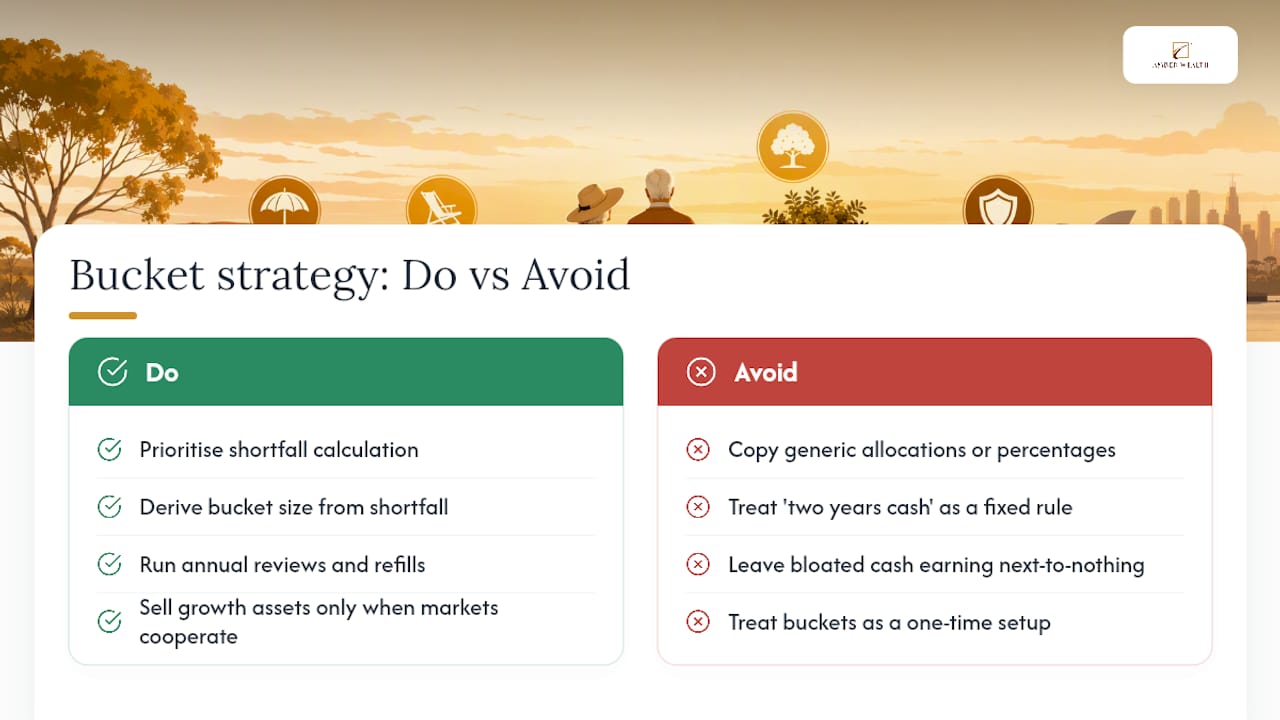
Too many retirees copy a generic allocation without first calculating what the Age Pension or a part-time income already covers. The result is bloated cash buckets earning next to nothing while inflation quietly erodes them, which is arguably a bigger long-term risk than the market crash the cash was meant to protect against. The strategy also gets treated as a one-time setup when it’s really an ongoing discipline, refill triggers, annual reviews, and the willingness to sell growth assets only when markets cooperate.
If you take one thing from this, prioritise the shortfall calculation over the bucket ratios. Get that number right first, guaranteed income minus real expenses, and the rest of the structure follows far more sensibly than starting with someone else’s percentages.
— Adam
How Amber Wealth can help you build your buckets
Turning a bucket strategy from a concept into numbers that match your actual life takes more than a rule of thumb, it takes a proper look at your cashflow, your Age Pension position, and how your superannuation is structured. Amber Wealth’s retirement planning service does exactly that, starting with a discovery conversation that covers your income shortfall, guaranteed income entitlements, and how each bucket should be sized against your actual spending.

From there, superannuation and SMSF advice helps structure the tax side of your long-term bucket, while investment management covers the medium and growth allocations themselves. This article is general information only and doesn’t take your personal circumstances into account, so treat it as a starting point rather than a plan. If you’d like to talk through your own numbers, consider contacting a Melbourne-based financial planning team for a conversation about your retirement structure.
Further reading and primary sources
- Morningstar’s bucket approach, three-bucket model origin and refill discipline
- Kiplinger’s bucket rule guide, behavioural benefits and allocation ranges
- SmartAsset’s bucket strategy breakdown, worked dollar example
- Thrivent’s market risk guidance, review cadence and refill triggers
This article is general information, not a substitute for advice from a qualified financial advisor. Consult a qualified financial professional about your own circumstances before acting on anything here.
Sources
- The Bucket Approach to Retirement Allocation | Morningstar
- The retirement bucket rule: your guide to fear-free spending | Kiplinger
- Retirement bucket strategy | SmartAsset
- Manage market risk in retirement with the bucket strategy | Thrivent
FAQ
What is the best retirement bucket strategy?
There’s no single “best” version, the right split depends on your guaranteed income, expenses, and risk tolerance, but a common starting point holds one to two years of expenses in cash, five to eight years in conservative assets, and the rest in growth investments, per Kiplinger’s framework.
What is the number one mistake retirees make with bucket strategies?
Sizing buckets against gross living expenses instead of the shortfall left after Age Pension or other guaranteed income, which leaves far more cash sitting idle than necessary and lets inflation erode it over time.
How much super do I need to retire on $70,000 a year?
The figure depends heavily on how much of your annual expenses the Age Pension and other guaranteed income already cover, since the bucket strategy only needs to fund the shortfall, not the full amount. A financial planner can model this shortfall against your specific entitlements and expected retirement length.
How do I know if a bucket strategy suits me over other retirement income approaches?
It suits retirees who want a clear, visible cash buffer and are comfortable with periodic rebalancing; if you’d prefer a simpler set-and-forget income stream, an account-based pension paired with guaranteed income sources may need less ongoing management. Comparing the two against your own goals is worth doing with an adviser before committing to either.
Recommended
- Age Pension Strategies
- Age Pension eligibility: age, residency and the income and assets tests
- Australians: Avoid Costly Timing Mistakes with Super and the Age Pension
- Retirement income strategies that turn savings into a paycheck
This article is general information, not a substitute for advice from a qualified financial advisor. Consult a qualified financial professional about your own circumstances before acting on anything here. General Advice Warning Disclaimer: The information on this website is general information only and is not intended to be a recommendation. We strongly recommend you seek advice from your financial adviser as to whether this information is appropriate to your needs & financial situation.
Adam Sobczak
Director & Senior Financial Planner, Amber Wealth
Amber Wealth is a Corporate Authorised Representative of Lifespan Financial Planning Pty Ltd, AFSL 229892.
Book a complimentary consultationLooking for professional advice on investment?
Explore our Investment Management service →