
SMSF borrowing rules for trustees: what to check first

SMSFs can borrow, but only through two tightly defined pathways. The first covers short-term limited borrowings for specific purposes, capped at 90 days (or 7 days for settlement) and no more than 10% of total fund assets. The second is a limited recourse borrowing arrangement (LRBA), which allows an SMSF to acquire a single acquirable asset using borrowed funds held in a separate holding trust. Every other form of borrowing within an SMSF is prohibited under the Superannuation Industry (Supervision) Act 1993 (SIS Act).
One critical update for 2026: legislation passed this year%20Bill%202026_McKim.pdf;fileType=application%2Fpdf) prevents new SMSF LRBAs from being used to acquire residential property from 10 August 2026. Trustees with existing residential LRBAs are generally protected, but anyone planning a new residential property purchase through an LRBA needs to reconsider their strategy now.
Key takeaways
| Point | Details |
|---|---|
| Short-term borrowing limits | Maximum 90 days for benefits/surcharge, 7 days for settlement, and no more than 10% of fund assets. |
| LRBA structure essentials | A holding trust must hold legal title; the loan must fund a single acquirable asset only. |
| Related-party lending risk | Without arm’s-length documentation benchmarked to PCG 2016/5, NALI tax at the top marginal rate applies. |
| 2026 residential LRBA ban | New LRBAs for residential property are prohibited from 10 August 2026; existing compliant arrangements are generally preserved. |
| Amberwealth guidance | Amberwealth provides SMSF advice, cashflow modelling, and lender introductions to help trustees borrow compliantly. |
Table of Contents
- 1. Short-term borrowing exceptions you need to understand
- 2. What is a limited recourse borrowing arrangement?
- 3. Core rules for entering and operating an LRBA
- 4. Related-party lending and arm’s-length requirements
- 5. How in-house asset rules interact with LRBAs
- 6. Practical loan limits, LVR expectations, and valuation requirements
- 7. Documentation and record-keeping for LRBA compliance
- 8. Common LRBA breaches and their consequences
- 9. Trustee checklist before signing any LRBA
- 10. When borrowing inside an SMSF makes sense, and when it does not
- Amberwealth’s SMSF and LRBA advisory services
- Sources
1. Short-term borrowing exceptions you need to understand
The SIS Act carves out three narrow situations where an SMSF may borrow on a short-term basis without triggering a contravention. Each comes with strict numeric limits that leave no room for interpretation.
The three permitted short-term purposes are:
- Paying a member benefit that is currently due and payable.
- Meeting an outstanding surcharge liability owed by the fund.
- Covering settlement of a security transaction where the fund has already committed to the purchase.
The numeric limits are equally precise. Borrowings for paying benefits or meeting a surcharge liability must be repaid within 90 days. Settlement borrowings carry a tighter ceiling of 7 days.
The 7-day settlement rule has an additional practical test: the borrowing must have been unlikely at the time the transaction was entered into. If a trustee knew the fund would need to borrow to settle, the exception does not apply. This matters most for trustees who commit to share purchases or property settlements before confirming the fund has sufficient liquid assets.
An auditor will look for all three.
2. What is a limited recourse borrowing arrangement?
An LRBA is the primary vehicle for longer-term borrowing within an SMSF. The structure has two defining features that distinguish it from ordinary borrowing.
First, the acquirable asset rule. The borrowed funds must be used to acquire a single acquirable asset, or a collection of assets that are identical and have the same market value. Real property, certain listed share parcels, and managed fund units can all qualify, provided each LRBA covers only one such asset or collection. You cannot bundle a residential property and a share portfolio into a single LRBA.
Second, the holding trust. Legal title to the asset sits in a separate holding trust (sometimes called a bare trust) until the loan is fully repaid. The SMSF holds a beneficial interest throughout. Once the debt is extinguished, legal title transfers to the SMSF. Grant Thornton notes that this structure requires its own legal documentation and that misalignment between the holding trust deed and settlement documents can trigger serious, hard-to-fix tax consequences.
The “limited recourse” element means the lender’s remedy on default is generally confined to the LRBA asset itself. Other SMSF assets are protected. That protection only holds, though, if the structure is set up correctly from day one.
3. Core rules for entering and operating an LRBA
Getting into an LRBA is one thing. Staying compliant throughout its life is another. The following requirements apply from the moment a trustee signs the loan documents.
- Trust deed authority. The SMSF trust deed must expressly permit the fund to borrow and enter an LRBA. If it does not, the arrangement is a contravention before a dollar changes hands.
- Separate holding trust. A distinct holding trust must be established with legal title in the trustee of that trust, not the SMSF trustee. The two entities are separate.
- Single acquirable asset. The LRBA must acquire one asset (or identical collection). The ATO’s guidance on LRBA asset rules explains that multiple property titles under one LRBA are only permissible where they are distinctly identifiable as a single asset.
- No existing fund assets. Borrowed money must acquire a new asset. You cannot transfer an asset the SMSF already owns into an LRBA structure.
- Repairs, not improvements. Borrowed funds can cover repairs and maintenance on the LRBA asset. They cannot fund improvements that change the character of the asset. This distinction is frequently misunderstood and regularly triggers contraventions.
- Replacement asset restrictions. Once an LRBA is in place, the asset held in the holding trust generally cannot be replaced with a different asset. Narrow exceptions exist but require careful legal analysis.
- Each drawdown reviewed. If the LRBA involves multiple drawdowns, each one must independently satisfy the super law requirements. A compliant first drawdown does not protect a non-compliant second.
4. Related-party lending and arm’s-length requirements
A related party, such as a company the trustees control or a family trust, can lend to an SMSF under an LRBA. The law does not prohibit it. What the law does require is that the terms reflect what a commercial lender would offer at arm’s length.
The ATO’s guidance on LRBA lender relationships makes clear that trustees must be able to demonstrate their terms are consistent with what a non-related commercial lender would offer, with additional safeguards applying to arrangements entered from 7 July 2010.
PCG 2016/5 provides a safe harbour framework. If trustees structure their related-party LRBA to match the safe harbour terms, the Commissioner will accept the arrangement as consistent with arm’s-length dealing for NALI purposes. The safe harbour tables specify benchmarks for real property and listed securities separately, covering interest rates (typically referenced to RBA indicator lending rates), maximum loan-to-value ratios (LVR), and loan term limits.
| Feature | Safe harbour approach | Non-safe-harbour risk |
|---|---|---|
| Interest rate | Benchmarked to RBA indicator lending rate for the asset class | NALI exposure if rate is below commercial equivalent |
| LVR | Specified maximum per asset class in PCG tables | Excess LVR may indicate non-commercial terms |
| Loan term | Maximum term specified per asset class | Longer terms may not reflect commercial reality |
| Documentation | Written loan agreement required | Absence of agreement is a red flag in any ATO review |
Pro Tip: Even if you use a commercial lender rather than a related party, keep a copy of the loan offer and any correspondence showing the rate was set at arm’s length. The ATO can still query whether the overall arrangement was structured to generate non-arm’s-length income.
5. How in-house asset rules interact with LRBAs
Without an exception, a holding trust in which a related party holds an interest could trigger this rule.
The SIS Act provides a specific exception for holding trusts used in compliant LRBAs. The exception applies when:
- The holding trust holds only the single acquirable asset that is the subject of the LRBA.
- The LRBA meets all the requirements of the super law.
- The asset would not be an in-house asset if the SMSF owned it directly.
The practical trap here is leasing. If the LRBA property is leased to a related party, the in-house asset exception for the holding trust does not automatically resolve the leasing issue. Business real property leased to a related party at market rent can qualify under a separate exception, but residential property leased to a related party generally cannot. Trustees who rent an LRBA property to a family member are almost certainly creating an in-house asset problem, regardless of the LRBA structure.
6. Practical loan limits, LVR expectations, and valuation requirements
Lenders offering SMSF LRBA loans typically apply stricter criteria than standard residential mortgages. Interest rates are generally higher, and lenders commonly require evidence of steady member contributions and rental income where the fund relies on it for loan servicing.
Under the PCG 2016/5 safe harbour framework, the LVR benchmarks differ by asset class. Real property LRBAs and listed securities LRBAs each have their own maximum LVR specified in the safe harbour tables. Exceeding those benchmarks does not automatically make an arrangement non-compliant, but it removes the safe harbour protection and shifts the burden of proof onto the trustee to demonstrate arm’s-length terms by other means.
Loan term is equally important. The safe harbour guidance specifies maximum loan terms per asset class, and those terms directly affect repayment amounts, cashflow planning, and whether the fund can service the debt without liquidating other assets. A longer loan term reduces monthly repayments but extends the period during which the fund carries leverage risk.
Valuations are not optional. Trustees must obtain independent valuations at the time of acquisition and at appropriate intervals thereafter. An outdated or unsupported valuation increases contravention risk, particularly if the ATO queries whether the LRBA asset was acquired at market value or whether related-party terms reflected the asset’s true worth. MoneySmart’s guidance on SMSFs and property reinforces that borrowing to buy property through an SMSF adds complexity and cashflow pressure, and that independent financial advice is strongly recommended before proceeding.
7. Documentation and record-keeping for LRBA compliance
An LRBA that is correctly structured but poorly documented is still a compliance risk. The following records are the minimum a trustee should hold:
- Signed loan agreement between the lender and the holding trust, specifying rate, term, repayment schedule, and security.
- Holding trust deed, correctly executed and reflecting the trustee of the holding trust as legal title holder.
- Contract of sale for the LRBA asset, showing the purchase price and settlement date.
- Independent valuation at acquisition and at each subsequent valuation date.
- Evidence of repayments and interest calculations, including bank statements showing loan servicing from the SMSF’s account.
- Lender correspondence, including any variation letters or refinancing documents.
- Trustee resolutions authorising the LRBA, each drawdown, and any material changes to the arrangement.
- Updated trust deed if the original deed was amended to permit borrowing.
The ATO requires SMSF records to be kept for a minimum of five years. For LRBA records, retaining documents for the life of the arrangement plus five years is a practical standard. When the LRBA asset is eventually transferred from the holding trust to the SMSF, that transfer event triggers its own documentation and potential stamp duty considerations depending on the state.
At audit time, the SMSF auditor needs to trace the full flow of LRBA funds: from the lender to the holding trust, through to the asset purchase, and then the ongoing loan servicing from the SMSF. Financial statements must reflect loan servicing correctly, with the loan liability shown separately from the SMSF’s other obligations.
8. Common LRBA breaches and their consequences
The most frequent LRBA contraventions share a common thread: trustees who understand the concept but underestimate the operational detail.
- Using borrowed funds as general cash. The borrowed amount must flow directly to the acquisition of the LRBA asset. Parking it in the SMSF’s bank account, even briefly, can constitute a breach.
- Funding improvements with borrowed money. Replacing a kitchen or adding a room is an improvement, not a repair. Borrowed funds used for improvements breach the SIS Act, regardless of whether the work adds value.
- Failing to document related-party terms. A verbal agreement with a related-party lender, or a written agreement with below-market rates, invites NALI treatment on all income derived from the LRBA asset.
- Improper replacement of LRBA assets. Swapping the asset in the holding trust for a different one without satisfying the narrow replacement asset rules is a contravention.
The tax consequences of a NALI finding are severe. Beyond NALI, contraventions under the SIS Act can attract administrative penalties, and in serious cases the ATO may make the fund non-complying, which triggers a tax liability on the fund’s entire assets.
Remediation steps depend on the nature of the breach. For documentation failures with a related-party lender, the first step is to prepare a compliant written agreement and benchmark the terms against PCG 2016/5 or current commercial rates. For structural breaches, refinancing through a commercial lender may be the cleanest solution. Voluntary disclosure to the ATO, where the breach is material, generally results in a more favourable outcome than waiting for an audit to surface the issue.
9. Trustee checklist before signing any LRBA
Before committing to an LRBA, work through this sequence:
- Confirm trust deed authority. Read the deed. If it does not expressly permit borrowing, amend it before proceeding.
- Run cashflow stress tests. Model loan repayments assuming the property is vacant for three to six months. Use Amberwealth’s superannuation calculator to project how loan servicing affects your retirement balance over time.
- Obtain an independent valuation. Commission a qualified valuer before signing the contract of sale.
- Confirm lender documentation. Ensure the loan agreement is in the holding trust’s name, not the SMSF’s name, and that all security arrangements reflect the LRBA structure.
- Benchmark arm’s-length pricing. If using a related-party lender, compare your proposed terms against PCG 2016/5 safe harbour benchmarks or current RBA indicator rates.
- Plan repayment sources. Identify which fund income streams will service the loan: member contributions, rental income, or other investment returns. Do not assume rental income will always be available.
- Check insurance and tax impacts. Confirm that existing fund insurance policies are not affected by the new asset, and consider whether the LRBA changes the fund’s tax position.
- Confirm the 2026 residential restriction. If the target asset is residential property, confirm whether the LRBA will be entered into before or after 10 August 2026. New residential LRBAs entered from that date are not permitted under the amended legislation.
Questions worth putting to any prospective lender: What evidence will you require of SMSF income flows? What are the refinancing options if the fund’s circumstances change? Are there restrictions on how the security property can be used?
Pro Tip: Ask your lender upfront whether they will accept a refinance to a commercial loan if your related-party arrangement later needs restructuring. Not all SMSF lenders offer this, and being locked into a related-party loan with deteriorating terms is a compliance problem that compounds over time.
10. When borrowing inside an SMSF makes sense, and when it does not
Borrowing inside an SMSF can genuinely accelerate retirement savings, particularly where business real property is involved and the fund has strong, predictable cashflows. The leverage effect is real, and the concessional tax environment of superannuation makes it more attractive than borrowing outside the fund in many cases.
That said, the risks are just as real. MoneySmart’s guidance is direct on this: SMSF property borrowing is complex, can create cashflow pressure, and is difficult to unwind once committed. The compliance burden is ongoing, not just at setup.
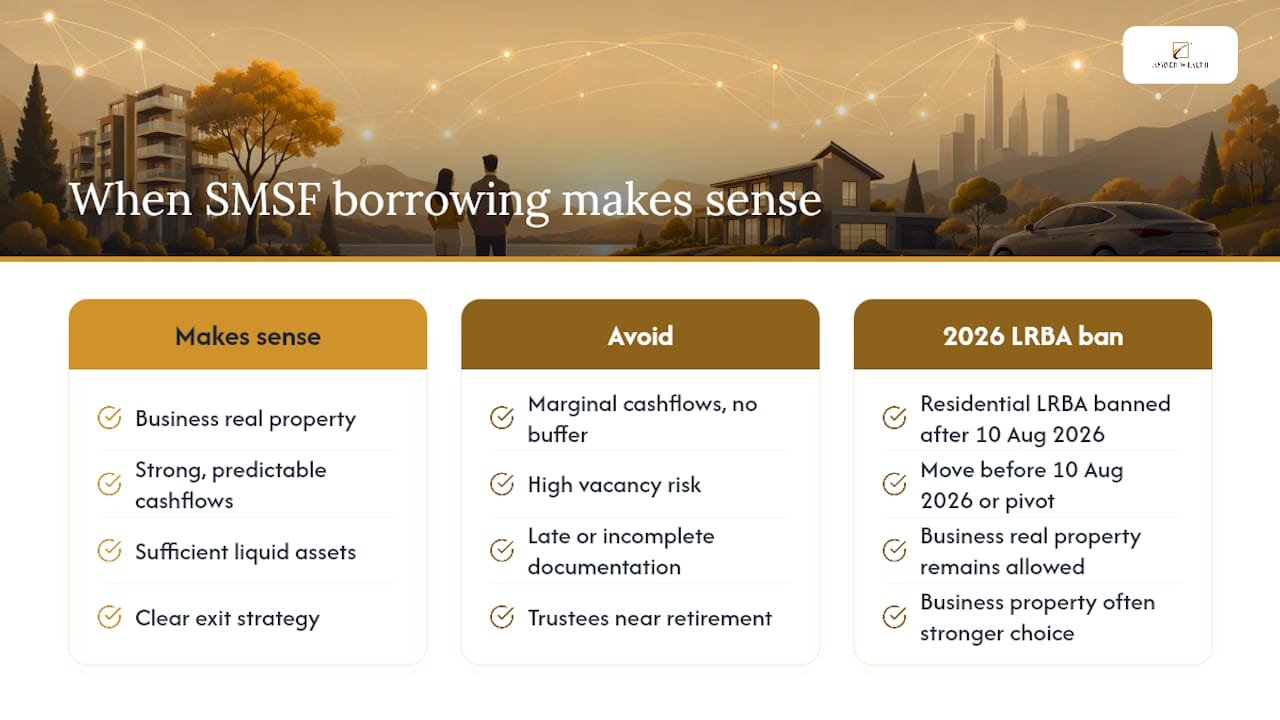
From a fiduciary standpoint, the cases where borrowing tends to make sense share a few characteristics: the fund has sufficient liquid assets to service the loan without relying entirely on rental income, there is a clear exit strategy (whether that is selling the asset or paying down the loan before retirement), and the trustees have the capacity to manage the compliance obligations or have engaged advisers who can.
The cases where avoidance is the wiser call are equally recognisable: marginal cashflows that leave no buffer for vacancy or rate rises, high vacancy risk in the target property market, documentation that is being assembled after the fact rather than before, and trustees who are approaching retirement with limited time to recover from a compliance misstep.
The 2026 residential LRBA ban adds another dimension. Trustees who were planning a residential property purchase through an LRBA and have not yet acted need to either move before 10 August 2026 or pivot to a different structure entirely. Business real property remains an acceptable LRBA asset after that date, and for many trustees it is the stronger strategic choice regardless.
Amberwealth’s SMSF and LRBA advisory services
Navigating SMSF borrowing regulations is not a DIY exercise. The compliance requirements are specific, the documentation standards are exacting, and the consequences of getting it wrong, from NALI exposure to SIS Act contraventions, are significant.

Amberwealth works with SMSF trustees across Victoria, New South Wales, South Australia, and Tasmania to review trust deeds, model loan servicing scenarios, and connect trustees with appropriate lenders. Our SMSF and superannuation advice covers the full LRBA lifecycle, from pre-borrow compliance checks through to ongoing fund reviews. For trustees who need lender introductions or want to assess refinancing options, our mortgage broking service can help identify structures that fit the fund’s cashflow and compliance profile. If you want to align your borrowing decision with your broader retirement goals, start with a retirement planning review to see how an LRBA fits your overall strategy.
Sources
The following official and authoritative sources are the best starting points for trustees who want to go deeper on the legal text or practical guidance:
- SMSF borrowing restrictions | Australian Taxation Office
- Moneysmart
- SMSF limited recourse borrowing arrangements: what are they and how do they work? | Grant Thornton Australia
Amber Wealth Pty Ltd (ABN 16 653 279 013) is a Corporate Authorised Representative (No. 1310815) of Lifespan Financial Planning Pty Ltd (ABN 23 065 921 735), holder of Australian Financial Services Licence (AFSL) No. 229892. Financial advice is provided by Adam Sobczak, ASIC Authorised Representative No. 1234769.
General Advice Warning Disclaimer: The information on this website is general information only and is not intended to be a recommendation. We strongly recommend you seek advice from your financial adviser as to whether this information is appropriate to your needs, financial situation and investment objectives. Whilst every care has been taken in the preparation of this website, Amber Wealth Pty Ltd, its directors, authors, consultants, editors and any persons involved in the construction of this website, expressly disclaim all and any form of liability to any person in respect of this website and any consequences arising from its use of this information.
This article is general information, not a substitute for advice from a qualified financial advisor. Consult a qualified financial professional about your own circumstances before acting on anything here.
Recommended
Adam Sobczak
Director and Principal Adviser, Amber Wealth
Amber Wealth is a Corporate Authorised Representative of Lifespan Financial Planning Pty Ltd, AFSL 229892.
Book a complimentary consultationLooking for professional advice on superannuation?
Explore our Superannuation & SMSF Advice service →