
TPD insurance in super: how it works and how to claim

TPD insurance in super pays a lump sum if you become permanently unable to work because of illness or injury and you meet your fund’s definition of total and permanent disablement. If you think you might qualify, do three things now: pull up your fund’s Product Disclosure Statement (PDS) and insurance guide to check what cover you actually hold, start gathering medical notes and identification, and call your fund or a financial adviser before you lodge anything formal.
Most Australians have this cover without realising it, buried inside their default super policy. Premiums come out of your balance quietly, year after year, and plenty of members never open the insurance guide until they need it. That’s the worst time to find out what “permanent” and “disablement” actually mean under your specific policy.
Pro Tip: Contact your super fund early, even before you have a complete medical picture. Ask them to confirm exactly which TPD definition applies to your cover, because “any occupation” and “own occupation” tests lead to very different claim outcomes.
Key Takeaways
TPD insurance in super pays a lump sum for permanent incapacity, but the any occupation definition, tax on release, and evidence quality determine whether a claim actually succeeds.
| Point | Details |
|---|---|
| Check your definition first | Most in-super TPD uses an any occupation test, which is harder to meet than own occupation cover held outside super. |
| Frame medical evidence to the policy | Ask specialists to explicitly address your fund’s TPD test, not just describe your diagnosis. |
| Tax applies on release | Payouts can be taxed at up to 22% if you’re under 60 when the benefit is released from super. |
| Use AFCA if a claim is denied | Escalate a refused claim through internal review first, then AFCA as the free external dispute pathway. |
| Get your cover reviewed | Amber Wealth can assess whether your fund’s default TPD cover matches your actual debts and income needs. |
Where to read further
Consult these sources for official definitions and calculators, and always check your own fund’s PDS and insurer policy document for the final word: Moneysmart on TPD insurance, APRA, AFCA, SuperGuide’s TPD calculator, and the ATO.
Table of Contents
- What TPD insurance in super actually covers
- TPD in super versus a standalone policy: what’s the real difference?
- Who gets TPD cover automatically, and how much do you actually need?
- How do you check if you have TPD cover in your super?
- How to make a TPD claim through your super fund
- What happens after your claim is decided, and what if it’s refused?
- Questions to ask your super fund right now
- When to bring in a financial adviser
- Get your TPD cover reviewed before you need it
- Frequently asked questions
- Sources
What TPD insurance in super actually covers
TPD insurance pays a lump sum when illness or injury permanently stops you from working, but “permanently” is doing a lot of legal work in that sentence. Insurers use specific tests, and which one applies to you depends on your policy.
- Own occupation: you’re assessed against your ability to do the specific job you were trained for or last worked in. A surgeon who loses fine motor control in one hand could meet this test even if they could still work a desk job.
- Any occupation: you’re assessed against your ability to do any job reasonably suited to your education, training, or experience. That same surgeon might not meet this test if they could retrain into medical administration.
- Activities of daily living (ADL): used mainly for older members or those without an active occupation, this test looks at whether you can independently manage basic tasks like dressing, bathing, and moving around.
Here’s the detail that catches people out: own occupation cover is generally only available outside super, while cover inside super almost always defaults to the any occupation test. That’s a materially harder bar to clear, and it’s one reason claims through super get knocked back more often than people expect.
TPD often gets confused with trauma (critical illness) cover, but they trigger differently. Trauma pays out on diagnosis of a specified condition, such as cancer or a heart attack, regardless of whether you can still work. TPD pays when you can no longer work at all. Comparing trauma vs TPD insurance matters because the two serve genuinely different cash flow roles — trauma can cover immediate treatment costs while you’re still working, and TPD addresses the longer-term reality of not working again.
TPD in super versus a standalone policy: what’s the real difference?
The trade off comes down to convenience versus flexibility, and it’s worth understanding before you assume your default cover is “good enough”.
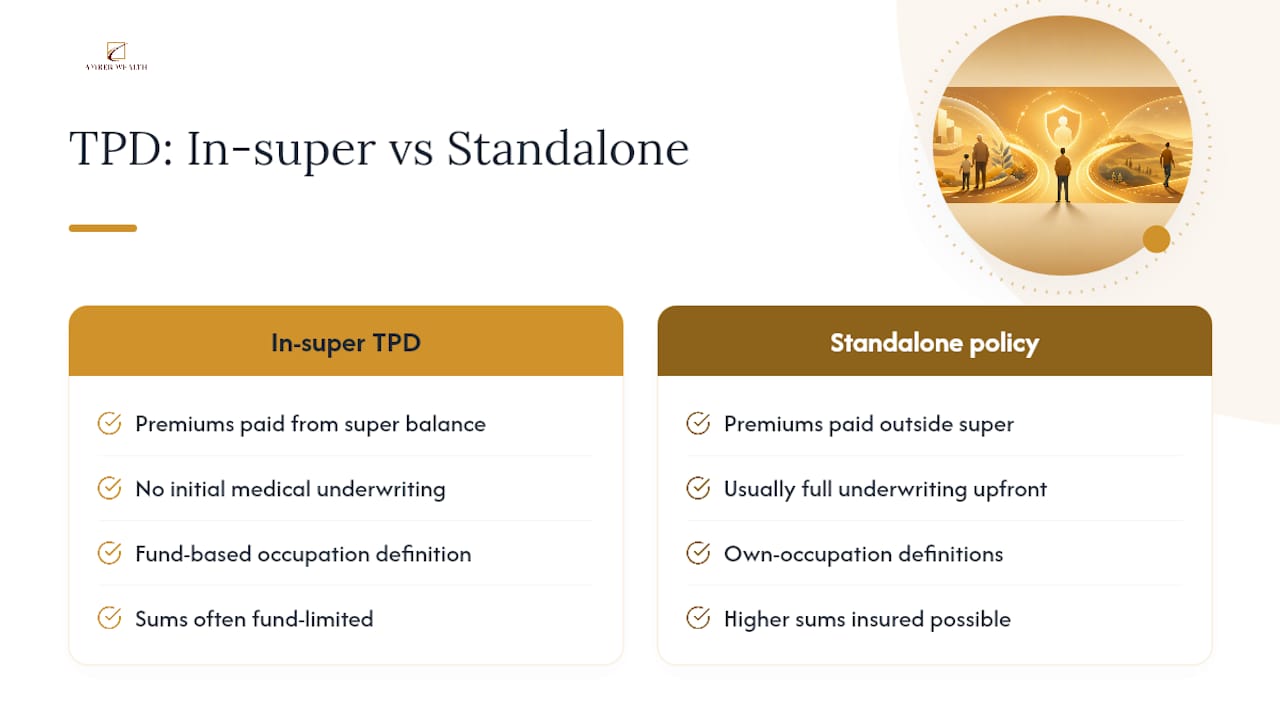
Premiums for in-super TPD come straight out of your super balance, which feels painless but quietly erodes your retirement savings over decades. Most super funds provide default TPD cover automatically for eligible members with no medical underwriting required at the outset, which is genuinely valuable if you’d struggle to get cover approved on health grounds. A standalone retail policy usually requires full underwriting upfront, but it can offer own occupation definitions, higher sums insured, and cover that isn’t tied to your super balance or fund membership.
Tax treatment differs too. A TPD payout made through super can be taxed at up to 22% if you’re under 60 when you withdraw it, whereas a standalone policy pays the benefit directly to you outside super, generally tax free. That gap between the insured amount and what actually lands in your pocket is one of the most overlooked numbers in retirement planning.
Pro Tip: If you’re self-employed, work in a specialised profession, or could salary sacrifice extra contributions to fund better cover, it’s worth asking an adviser whether an external own occupation policy makes more sense than relying solely on your fund’s default TPD.
Who gets TPD cover automatically, and how much do you actually need?
Default TPD cover typically kicks in automatically once you turn 25, your balance reaches $6,000, and you’ve received a contribution, though funds vary on the exact triggers. Cover usually ends at a set age (often 65 or 70) and can lapse entirely if your account goes inactive for 16 months with no contributions, unless you’ve opted to keep it running.
Working out how much cover you need isn’t complicated, even if most people never sit down and do it properly. SuperGuide’s calculator framework breaks it into three components:
- Total your debts — mortgage, personal loans, credit cards, anything that wouldn’t disappear if your income did.
- Estimate your income shortfall — work out what lump sum, if invested, would replace the income you’d lose until retirement age.
- Add one-off costs — home modifications, ongoing medical treatment, or equipment you’d need if you couldn’t work again.
A person with a mortgage, family, and years left in the workforce might require a sum significantly higher than the typical default cover many funds provide, which is why reviewing your level of cover matters as much as knowing you have it. Run the numbers through a superannuation calculator and remember to gross up your target for tax, since a payout taxed at 22% needs to start higher to deliver the after-tax amount you actually require.
How do you check if you have TPD cover in your super?
Log into your fund’s online portal first. Most funds display current insurance cover, including TPD, on the account dashboard or in your latest annual statement.
- Download the current PDS and insurance guide — these documents spell out the exact TPD definition, sum insured, premium cost, and any exclusions that apply to you.
- Check your member statement for the insurance premium line item and the level of cover listed.
- Note the eligible service date, since this affects tax calculations if you later make a claim.
- If your super was ever transferred to the ATO as unclaimed money, check with the ATO directly because insurance cover doesn’t travel with the balance. Any TPD cover is cancelled the moment funds move to the ATO, and you’d need to claim through your original fund’s records instead.
Pro Tip: Save a copy of your PDS and insurance guide the day you find them. Funds update these documents regularly, and the version that applied when you were first covered is the one that matters if you make a claim years later.
How to make a TPD claim through your super fund
Start by confirming the exact definition your fund applies. This single step shapes everything that follows, because the medical evidence you gather needs to speak directly to that test, not just describe your condition in general terms.
- Request the claim forms from your fund, along with a copy of the insurer’s TPD definition in writing.
- Gather certified identification — a certified copy of a government issued photo ID is mandatory, and an uncertified photocopy is routinely rejected, which is one of the most common and entirely avoidable causes of delay.
- Collect medical evidence, including GP records, specialist reports, and hospital discharge summaries covering your diagnosis, treatment, and prognosis.
- Obtain an employer statement confirming your role, duties, and the date you stopped working, plus a summary of your broader work history if you’re being assessed against an any occupation test.
- Submit the completed claim form with all supporting documents attached, and keep copies of everything you send.
Once lodged, the insurer typically takes several months to assess a TPD claim, sometimes longer for complex medical cases requiring independent medical examinations. After a decision, an approved benefit is paid into your super account, and you then need to apply separately to release it under the TPD condition of release.
The single biggest lever you control is the quality of your medical evidence. Reports that simply describe a diagnosis are often insufficient — what insurers actually need is a specialist letter stating plainly that you cannot perform the specific duties required under your policy’s test.
- Ask your specialist to reference the policy definition by name in their report.
- Request that they address your capacity for any suitable occupation, not just your former role, if that’s the test you’re being assessed against.
- Provide a full employment history so the insurer can’t argue you’re qualified for roles you’ve never held.
Pro Tip: Ask your GP or specialist to write their report as if the insurer has never met you. Vague clinical language like “significant limitations” gets challenged far more often than specific statements like “cannot stand for more than ten minutes” or “cannot use the right hand for repetitive tasks”.
What happens after your claim is decided, and what if it’s refused?
An approved claim doesn’t hand you cash directly. The insurer pays the lump sum into your super account first, and you then submit a separate application to your fund to release it under the TPD condition of release. Only then does the money become accessible.
Tax applies at this release stage. If you’re under 60, the taxable component of a TPD payout can be taxed at up to 22%, which is why the gross sum insured and the amount you’ll actually receive can differ substantially. Some members choose to take the benefit as a lump sum, others convert part of it into an income stream, and the right choice depends on your age, other assets, and whether you’re also drawing on income protection at the same time.
Claims get denied for a handful of recurring reasons:
- The medical evidence didn’t specifically address the policy’s definition, even if the condition itself was well documented.
- A pre-existing condition exclusion applied because the illness or injury existed before cover started.
- The fund assessed you as capable of any suitable occupation, even though you could no longer do your specific job.
- Documentation was incomplete, delaying or derailing the assessment entirely.
If your claim is refused, you’re not out of options. Start with your fund’s internal review process, submitting any additional medical evidence that more directly addresses the definition you were assessed against. If that fails, you can escalate to the Australian Financial Complaints Authority (AFCA), the independent external dispute resolution body for financial services complaints, free to use and designed specifically for situations like this.
Questions to ask your super fund right now
Print this list or save it before you call. A ten-minute conversation with your fund can save you weeks of confusion later.
- Do I currently have TPD cover, and what’s the sum insured?
- Which definition applies: own occupation, any occupation, or activities of daily living?
- What premium am I paying, and has that amount changed recently?
- Does my cover continue if I go on unpaid leave or my account becomes inactive?
- What’s my eligible service date, and why does it matter for tax purposes?
- What specific documents will the insurer need if I lodge a claim?
Watch for warning signs while you’re at it. If your fund can’t produce a current PDS, gives you a vague answer about the definition used, or your premium history looks inconsistent year to year, push for written clarification before you rely on that cover for anything.
When to bring in a financial adviser
Complex medical cases, disputes over which TPD definition applies, or claims involving large sums insured are exactly where professional advice earns its keep. So is any situation where the tax and release rules aren’t clear to you, because getting that wrong can mean losing thousands unnecessarily.

A financial adviser can run a proper insurance needs analysis, tell you honestly whether your current cover through superannuation advice is enough, and help you decide whether a standalone policy outside super is worth the higher premium. They can also liaise directly with your fund and insurer during a claim, which matters when you’re dealing with a serious illness or injury and simply don’t have the energy to chase paperwork.
Amber Wealth specialises in retirement and superannuation advice for Australians navigating exactly this kind of decision, and can help you assess whether your current cover matches your actual circumstances.
Adam’s take: why the paperwork matters more than the policy
Most guides to TPD insurance spend their time explaining what the cover is. Fewer explain why so many legitimate claims still get knocked back. In my experience working with clients through claims, it’s rarely because someone wasn’t genuinely unable to work. It’s because the medical evidence described their condition instead of addressing the specific legal test their policy applied.
That’s a fixable problem, and it’s why this guide leans so heavily on the practical steps: check your definition first, brief your specialist properly, and don’t assume default cover is adequate just because it exists. Amber Wealth works with clients across retirement and super advice, and cover review is one of the most common gaps we find.
Get your TPD cover reviewed before you need it
If you’ve read this far wondering whether your own cover would actually hold up, that uncertainty is the whole problem with default TPD insurance. Amber Wealth reviews your super fund’s PDS, insurance guide, and current sum insured against your actual debts and income needs, then tells you plainly whether you’re covered, underinsured, or paying for a definition that doesn’t suit your occupation.

Book a consultation through our retirement planning advice service and bring your most recent member statement, your fund’s PDS and insurance guide, any employer statements relevant to your work history, and medical summaries if you already have them. If you’re closer to claiming than reviewing, we can also help you understand tax and release implications before you lodge anything with your fund. Get in touch to arrange a first appointment and find out exactly where you stand.
Frequently asked questions
Is TPD insurance automatically included in my super? Most super funds provide default TPD cover for eligible members once you meet age and balance thresholds, but it’s not universal and cover can lapse if your account becomes inactive.
What’s the difference between trauma insurance and TPD insurance? Trauma pays a lump sum on diagnosis of a specified condition regardless of your ability to work, while TPD pays only when you’re permanently unable to work at all.
Can I claim TPD and income protection at the same time? Yes, many people hold both, since income protection replaces ongoing income during a claim period while TPD provides a separate lump sum for longer-term adjustments and debt repayment.
How long does a TPD claim take to process? Timelines vary by complexity, but assessment commonly takes several months from lodgement to decision, longer if independent medical examinations are required.
Is TPD paid from super taxed? Yes, the taxable component can be taxed at up to 22% if you’re under 60 when the benefit is released from your super account.
Amber Wealth Pty Ltd (ABN 16 653 279 013) is a Corporate Authorised Representative (No. 1310815) of Lifespan Financial Planning Pty Ltd (ABN 23 065 921 735), holder of Australian Financial Services Licence (AFSL) No. 229892. Financial advice is provided by Adam Sobczak, ASIC Authorised Representative No. 1234769.
General Advice Warning Disclaimer: The information on this website is general information only and is not intended to be a recommendation. We strongly recommend you seek advice from your financial adviser as to whether this information is appropriate to your needs, financial situation and investment objectives. Whilst every care has been taken in the preparation of this website, Amber Wealth Pty Ltd, its directors, authors, consultants, editors and any persons involved in the construction of this website, expressly disclaim all and any form of liability to any person in respect of this website and any consequences arising from its use of this information.
This article is general information, not a substitute for advice from a qualified financial advisor. Consult a qualified financial professional about your own circumstances before acting on anything here.
Sources
Recommended
Adam Sobczak
Director and Principal Adviser, Amber Wealth
Amber Wealth is a Corporate Authorised Representative of Lifespan Financial Planning Pty Ltd, AFSL 229892.
Book a complimentary consultationLooking for professional advice on superannuation?
Explore our Superannuation & SMSF Advice service →