
Retire with a Mortgage: Your Options in Australia

Yes, you can retire with a mortgage in Australia, and many people do. Moneysmart says many Australians retire with money still owing on a home loan, car loan or other debts. The real question is whether the repayments fit your retirement income, and which way of clearing the loan (super, downsizing or keeping it) leaves you with the most secure income and the right Age Pension outcome. That is a sequencing problem across super, tax and Centrelink, and it is where a retirement planning adviser earns their keep. At Amber Wealth, retirement planning is our primary specialty.
TL;DR
- A mortgage is not a barrier to retiring, but the repayments must be covered by reliable retirement income, not hoped-for growth.
- Your home is exempt from the Age Pension assets test, so money used to clear the loan can change your pension entitlement.
- Lenders typically want a credible exit strategy once a loan runs past retirement age, so plan any refinance before you stop work.
- Super, a downsizer contribution or downsizing are the main ways to clear a loan. Each has tax and benefit consequences to model first.
- If repayments are already a struggle, you have hardship rights and free support.
Table of Contents
- Step one: test whether the repayments fit your retirement income
- Pay it off or keep it? The case for clearing the loan
- Ways to clear the loan
- Refinance before you retire, not after
- If repayments are already a strain
- Your retirement date is not the same as your pension date
- Where we come in
- Our perspective
- FAQ
- Sources
Step one: test whether the repayments fit your retirement income
Start with a plain list: the loan balance, the rate, the repayment, the remaining term and your planned retirement date. Then set the annual repayment against income you can rely on after you stop work: account-based pension payments from super, part-time earnings, rent and any Age Pension.
Compare that with what retirement costs. The ASFA Retirement Standard estimates the lump sum a homeowner couple needs at $730,000 for a comfortable retirement and $630,000 for a single person, or $120,000 and $110,000 for a modest one. Those figures assume you own your home outright. If you still owe money, the balance comes off what is available for living costs, so the gap matters.
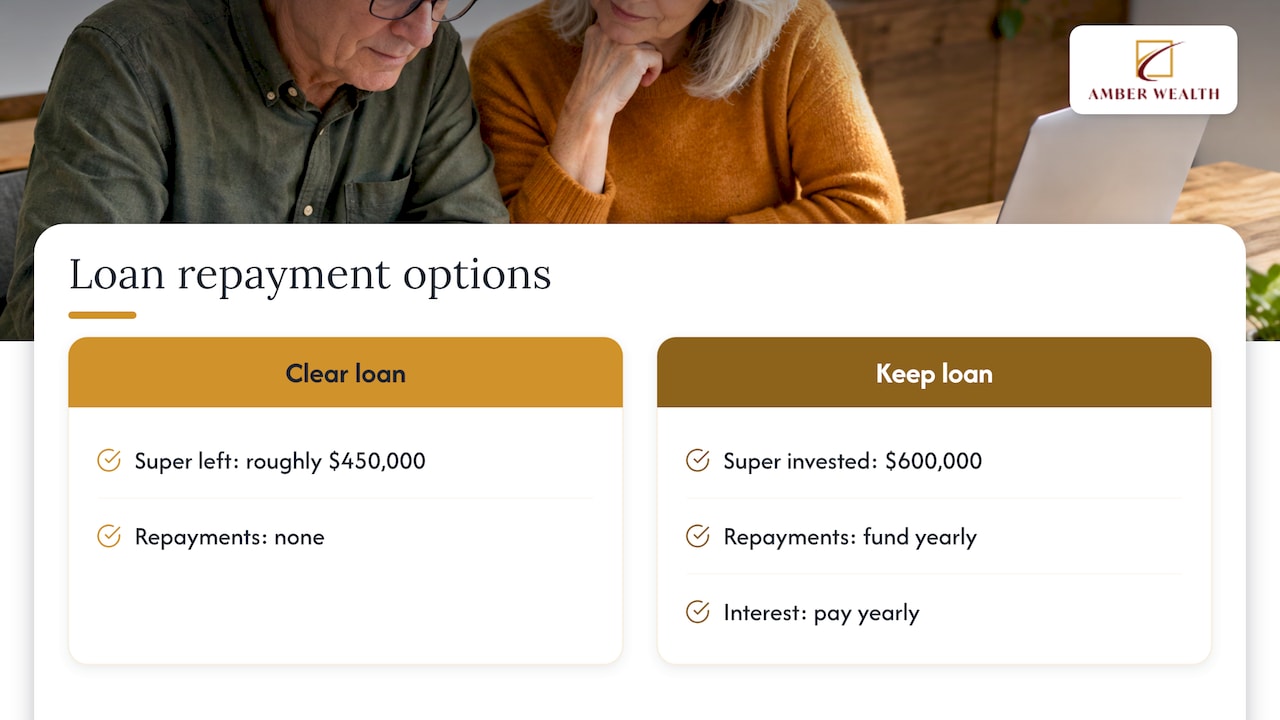
A worked example: a couple with $600,000 in super and a $150,000 loan. If they clear the loan from super, they have roughly $450,000 left to generate income but no repayments. If they keep the loan, they keep $600,000 invested but must fund the repayments, and interest, every year. Which is better depends on the loan rate, the investment return after tax and fees, and what each choice does to their pension. That last point is the one most people miss.
Pay it off or keep it? The case for clearing the loan
Paying down a loan delivers a return equal to the loan’s interest rate, with certainty. Investment returns are not certain, and in retirement, falling markets while you draw income can hurt more than they do in your working years. Removing a fixed repayment also lowers the income you need each year, which can make a smaller super balance last longer.
Tax helps here. CPA Australia’s guide notes the taxed element of a super lump sum is taxed at 0% from age 60. For most people with a typical taxed fund, taking a lump sum to clear the loan after 60 does not trigger tax on the withdrawal. Moneysmart’s advice is still to check the tax impact and the effect on government benefits first. We cover the detail in our guide to avoiding super tax after 60.
The Age Pension effect
Services Australia says the principal home is the only real estate excluded from the assets test, and that spending a lump sum on an exempt asset, including your home or mortgage, does not affect you under the assets test. Savings sitting in the bank or invested, by contrast, are assessed.
That can be powerful. In Moneysmart’s example, Bill, 67, has a home worth $875,000 and a $200,000 loan and does not qualify for the Age Pension. When he takes $200,000 from super to pay off the loan, his assessable assets fall to $600,000, below the cut-off, and he becomes eligible for the pension and its concessions.
For reference, the Department of Veterans’ Affairs lists the assets test limits (effective 20 September 2026) at $333,000 for a single homeowner and $499,000 for a homeowner couple before the full pension starts to reduce, with the payment falling by 75 cents per $250 of assets above that. These thresholds are indexed, so check the live figures. Our explainers on the assets test thresholds and the income test show how to model both tests, and our Age Pension strategies work is built around exactly this decision.
Ways to clear the loan
Use your super
Once you have met a condition of release (Moneysmart notes you can generally access super if you’ve left a job after turning 60), a lump sum can retire the debt. The trade-off is a smaller balance producing future income, so test how long the remainder lasts.
Make a downsizer contribution
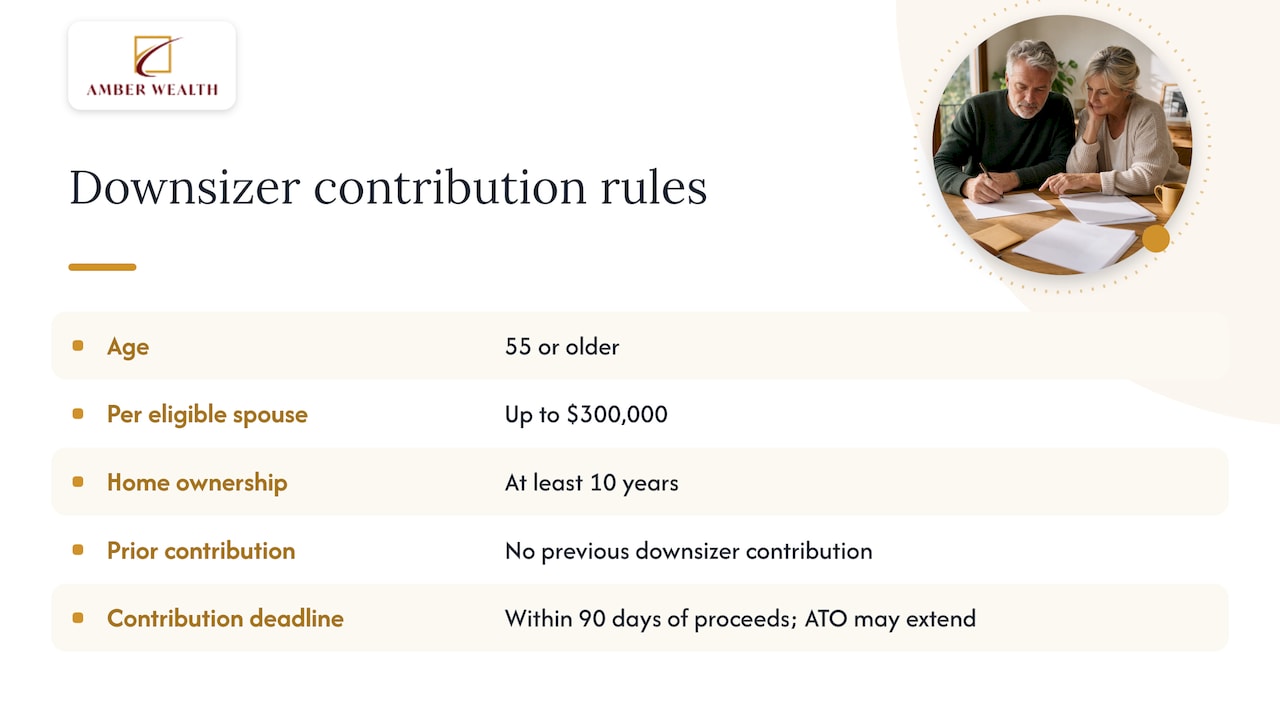
If you sell and move to a cheaper home, the ATO lets anyone 55 or older contribute up to $300,000 of the sale proceeds into super, with each eligible spouse able to do the same. It sits outside the usual contribution caps. The conditions include owning the home for at least 10 years, not having made a previous downsizer contribution, and contributing within 90 days of receiving the proceeds unless the ATO grants an extension. The age was lowered from 65 to 60 on 1 July 2022 and to 55 on 1 January 2023, per ATO data. See our downsizer contribution rules for the timing traps.
Note that money moved into super after Age Pension age is assessed, so the home sale can lift your assessable assets even as it clears the loan.
Downsize and keep the difference
Moneysmart lists downsizing as a way to free up money, with moving costs, and a possible effect on your Age Pension and other benefits. Stamp duty, agent fees and the emotional cost of leaving a neighbourhood all belong in the sums.
Release equity
If you want to stay put, equity release is the last lever rather than the first. Moneysmart explains that a reverse mortgage is available from age 60, that the most you can borrow at 60 is likely 15% to 20% of the home’s value (adding about 1% for each year over 60), and that interest compounds, with repayment due when you sell, move out or your estate sells the home. Loans from 18 September 2012 carry negative equity protection.
The government’s Home Equity Access Scheme offers people at Age Pension age or older a voluntary, non-taxable loan secured on Australian real estate, at 3.95% a year compounding fortnightly (the rate is set by Services Australia and can change), with a no-negative-equity guarantee.
Refinance before you retire, not after
Borrowing is easiest while you still have a salary. Lenders assess serviceability on income, and once your pay stops, your options narrow.
Money.com.au reports that more than 80% of the lenders it reviewed ask for a home loan exit strategy by age 55. Acceptable strategies include downsizing, a super lump sum, selling assets, retirement income or a younger partner’s income. Lenders generally do not accept future inheritances, projected super balances or the idea of refinancing later.
Before you refinance, work through this checklist:
- Write your exit strategy. Say how the loan will be cleared, with figures and a timeline.
- Check the term. A loan running well past your retirement date needs a stated plan.
- Count the costs. Break costs, discharge and application fees, and any rate you lose.
- Consider offset or redraw. Parking spare cash against the loan can cut interest while keeping it accessible, as this comparison of offset accounts and redraw explains.
- Know your property’s value. Loan-to-value ratio drives your rate and options, and an independent valuation can lower your LVR.
- Model the pension. Run the Age Pension result for each scenario before you sign.
Our mortgage broking service sits alongside our retirement advice, so the loan structure and the retirement plan are considered together.
If repayments are already a strain
Act early. Moneysmart’s advice is to list what you owe, who you owe and when payments are due, pay the most important debts first, and call the National Debt Helpline on 1800 007 007.
You also have rights. Under ASIC’s credit factsheet, if you cannot keep up with home loan repayments you can ask for a hardship variation, such as a longer loan period, postponed repayments or both, and the lender must respond in writing within 21 days. The same factsheet warns that rolling debts into a long home loan can mean paying more interest overall, and that equity stripping schemes can charge fees above 20% of your home equity. If the numbers will not work, it suggests the hard decision may be to sell or downsize rather than borrow against the home. Free financial counsellors can help you weigh that decision.
Your retirement date is not the same as your pension date
Timing matters. You may be able to retire at 60 but not receive the Age Pension until later, which means a gap to fund from super. Our guide to retirement age in Australia sets out the ages that apply, and our piece on timing mistakes with super and the Age Pension shows how the order of your moves changes the result.
Where we come in
Clearing a mortgage in retirement touches super, tax, the Age Pension and your lender at once. At Amber Wealth, we focus on pre-retirees and retirees, and our advice is based on your actual financial situation rather than templates. We cover retirement planning, superannuation and SMSF advice, Age Pension strategy and mortgage broking from our Melbourne practice, and we also advise clients across Australia where appropriate. Our process includes ongoing stewardship and regular reviews, so the plan keeps pace as your situation changes. If you would like to know whether you can retire with your loan, start with our retirement planning service.

We are fee-for-service and commission-based, depending on the service. Our guide to what financial adviser fees cost in Australia explains how advice is typically charged.
Our perspective
Most people who ask us about retiring with a mortgage are really asking two questions: can I stop work, and what is the best use of my super? The answer is rarely “always pay it off” or “always keep it”.
We start with the retirement income you need, then test each option against the Age Pension and tax rules. Often the home sits outside the assets test, so a dollar used to clear the loan can work harder than a dollar left invested. Sometimes the numbers say otherwise. The point is to see both outcomes in dollars before you commit.
We also want the loan question settled while you still have an income, because that is when you have the most choices. A plan built around your real situation, and reviewed regularly, gives you something to rely on when the pay cheques stop.
Adam
FAQ
What is the best age to have your mortgage paid off?
There is no single age, but a useful target is your retirement date, so repayments do not depend on retirement income. Lenders commonly want an exit strategy by the mid-50s, so planning should start well before then.
Does paying off my mortgage help my Age Pension?
It can. Your home is exempt from the assets test, so using savings or super to clear the loan reduces assessable assets. Moneysmart’s example shows a retiree moving from ineligible to eligible this way. Your result depends on your own assets, so model it first.
Is a reverse mortgage better than keeping my loan?
A reverse mortgage has no mandatory repayments, but interest compounds and the balance is repaid when you sell, move out or your estate sells the home. It suits some situations, and the Home Equity Access Scheme is a government alternative for people at Age Pension age. Compare both against selling or downsizing with an adviser.
Can I withdraw super to pay off my home loan?
Once you meet a condition of release, such as leaving a job after turning 60, you can generally take a lump sum. The taxed element is tax-free from 60, but the lower balance will affect future income, so work out the effect first.
Sources
- Work out how much you need to retire, Moneysmart
- ASFA Retirement Standard summary, February 2026
- CPA Australia super, tax and social security guide 2024-25
- Real estate assets, Services Australia
- Lump sums while on income support, Services Australia
- Assets test, Department of Veterans’ Affairs
- Managing unexpected retirement, Moneysmart
- Downsizer super contributions, ATO
- Downsizer contributions data, ATO
- Your home in retirement, Moneysmart
- Reverse mortgage and home equity release, Moneysmart
- Home Equity Access Scheme, Services Australia
- Home loan exit strategy, Money.com.au
- Credit factsheet: Can’t pay your debts, ASIC Moneysmart
Recommended
- Transition to retirement: your practical guide for Australians aged 60+
- Can I Afford to Retire?
- Retirement income strategies that turn savings into a paycheck
- Australians: Avoid Costly Timing Mistakes with Super and the Age Pension
This article is general information, not a substitute for advice from a qualified financial advisor. Consult a qualified financial professional about your own circumstances before acting on anything here. General Advice Warning Disclaimer: The information on this website is general information only and is not intended to be a recommendation. We strongly recommend you seek advice from your financial adviser as to whether this information is appropriate to your needs & financial situation.
Adam Sobczak
Director and Principal Adviser, Amber Wealth
Amber Wealth is a Corporate Authorised Representative of Lifespan Financial Planning Pty Ltd, AFSL 229892.
Book a complimentary consultationLooking for professional advice on retirement planning?
Explore our Retirement Planning service →

